Your refrigerator stopped cooling overnight. Your washing machine just flooded the laundry room. Your furnace is making a sound it has never made before, and of course it happened on a Tuesday in January when temperatures in Naperville are hovering near single digits. In that moment, you need more than general advice. You need a clear, practical way to think through one of the most frustrating financial decisions homeowners face: do you call a repair technician and fix what you have, or do you accept that this appliance has run its course and start shopping for a replacement?
The short answer: For most major appliances less than halfway through their expected service life, repair is almost always the better financial choice, provided the repair cost does not exceed 50 percent of what a comparable replacement would cost today. Once an appliance crosses the midpoint of its typical lifespan and begins requiring repeated repairs, the calculation shifts meaningfully toward replacement. The specifics vary by appliance type, failure mode, brand, and how efficiently the unit performs relative to current Energy Star standards. This guide walks through the decision appliance by appliance so you can make a confident, informed call rather than a panicked one.**
If you would like a professional diagnosis before deciding, Naperville Appliance Fix offers fast diagnostic service across Naperville and the surrounding DuPage and Will County communities so you have the repair cost number before you commit to anything.
The Two Numbers That Drive Every Repair vs. Replace Decision
Before diving into individual appliances, it helps to understand that this decision almost always comes down to two numbers sitting next to each other: the repair cost and the replacement cost. Everything else, including age, energy efficiency, brand quality, and parts availability, is context that helps you interpret how those two numbers relate to each other.
The repair cost is the written estimate from a qualified technician that covers parts, labor, and any additional work identified during the diagnostic. Never make a repair vs. replace decision based on a ballpark guess. A technician who has opened the appliance and identified the specific failure will give you a real number to work with.
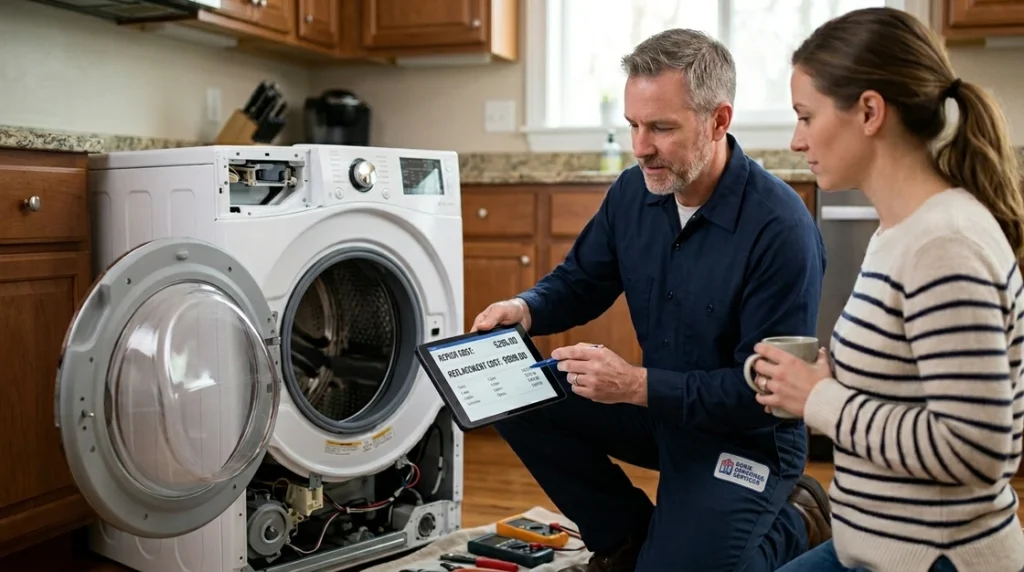
The replacement cost is what you would actually pay today for a comparable appliance of similar size, type, and feature set, not the retail sticker price of the most premium model available. For a 22 cubic foot side-by-side refrigerator that is mid-tier, the replacement cost is what a mid-tier 22 cubic foot side-by-side costs at a retailer today, not what a Sub-Zero costs.
Once you have both numbers, the 50 percent rule gives you the baseline guidance that appliance technicians and consumer advocates have used for decades: if the repair cost exceeds 50 percent of the replacement cost, replacement deserves serious consideration. If it comes in below 50 percent, repair is generally the financially sound choice.
That rule is a starting point, not a final verdict. Age, energy efficiency, repair history, and parts availability all modify the conclusion in ways this guide will walk through for each major appliance category.
Expected Lifespan: The Most Important Context for Every Decision
The 50 percent rule only makes sense when layered against the age of the appliance. A $400 repair on a 3 year old refrigerator is almost certainly worth it. The same $400 repair on a 12 year old refrigerator, one that is already nearing the end of its statistically expected service life, is a much more complicated call.
Here is a reliable reference for average appliance lifespans based on current industry data:
Refrigerators average 12 to 14 years. Front load washing machines average 10 to 12 years. Top load washing machines average 13 to 15 years. Gas dryers average 13 years. Electric dryers average 12 years. Dishwashers average 9 to 10 years. Gas ranges and ovens average 15 years. Electric ranges average 13 years. Gas water heaters average 8 to 12 years. Electric water heaters average 10 to 12 years. Tankless water heaters can last up to 20 years with proper annual descaling. Gas furnaces average 15 to 20 years. Central air conditioning systems average 12 to 15 years.
A helpful way to use these numbers is to think in terms of how far through its expected life an appliance is at the time it breaks down. An appliance at 30 percent of its expected lifespan is in a very different position than one at 80 percent, even if the repair cost is identical. The further an appliance is through its expected life, the lower the threshold where replacement starts to make more financial sense.
Refrigerator: Repair vs. Replace Decision Guide
The refrigerator is often the appliance that generates the most anxiety when it fails, partly because of food spoilage risk and partly because new refrigerators can be expensive. The good news is that most refrigerator failures are repairable at costs well below the replacement threshold.
Common refrigerator repairs that almost always make sense regardless of age include door gasket replacements ($100 to $180), thermostat or temperature sensor repairs ($100 to $200), defrost system repairs ($150 to $250), and water dispenser or ice maker line fixes ($100 to $220). These are relatively inexpensive repairs on components that wear independently of the overall mechanical health of the unit.
The repair calculus changes significantly when the compressor fails. A refrigerator compressor replacement in the Naperville area typically runs $700 to $1,250 for parts, labor, and the refrigerant recharge required after the work. For a refrigerator that costs $1,200 to $1,800 to replace, that repair cost bumps against or exceeds the 50 percent threshold. A compressor failure on a refrigerator that is already 8 to 10 years old is a situation where most experienced technicians would recommend replacement.
Control board failures, which can cost $200 to $600 to repair on modern smart refrigerators from Samsung, LG, or GE, sit in a middle zone. On a 5 year old unit, replacing the board almost always makes sense. On a 10 year old unit where the board failure may be signaling broader electronic wear, it is worth asking the technician whether there are other components that are likely approaching failure.
One important Naperville specific consideration: homes in the area often have a second refrigerator in an unheated garage. Standard residential refrigerators are not designed for garage environments where temperatures drop below 35°F during Illinois winters. If a garage refrigerator keeps failing and is not a garage ready model with a secondary thermostat heater, no repair will address the root cause of the repeated failures. That is a replacement situation that calls for a garage ready unit specifically.
Lean toward repair if the appliance is under 8 years old and the repair is not a compressor replacement. Lean toward replace if the appliance is over 10 years old, if the compressor has failed, or if you are dealing with a third repair in two years.
Washing Machine: Repair vs. Replace Decision Guide
Washing machines are workhorses, and most mid range and premium machines from brands like Whirlpool, Maytag, LG, and Samsung are genuinely worth repairing well into their lifespan, provided the failure is not at the core of the machine’s mechanical system.
Repairs that are nearly always worth making regardless of age include inlet valve replacements ($95 to $190), drive belt replacements ($100 to $200), lid switch or door latch fixes ($100 to $180), and pump replacements ($150 to $280). These are common wear components that fail independently of the drum, motor, and transmission.
Drum bearing failure is where the calculus gets more complicated. Replacing drum bearings runs $200 to $400 on most standard machines and considerably more on front loaders. If the machine is 8 years old or newer and was a higher quality unit when purchased, bearing replacement typically makes sense. If the machine is 10 or more years old, the motor and transmission may not be far behind the bearings in wear, which makes replacement a stronger option.
Motor and transmission failures on washing machines generally push the repair cost high enough that the 50 percent rule comes into play on most standard machines. Top load washing machines cost $600 to $1,400 to replace, and front load machines run $800 to $1,600 or more. A motor or transmission repair that runs $400 to $600 on an 8 to 10 year old machine is approaching or exceeding the 50 percent threshold depending on the unit’s replacement value.
Front load washers are generally worth more investment in maintenance and repair for the first 6 to 8 years of life because of their significantly better energy and water efficiency relative to top load machines. After that window, their greater mechanical complexity and the higher cost of parts like door boot seals, bearings, and control boards makes the repair calculation tighter.
Lean toward repair if the machine is under 8 years old and the failed component is not the motor, transmission, or drum. Lean toward replace if the machine is over 10 years old, if a core mechanical component has failed, or if you are dealing with recurring failures across multiple components.
For washing machine repair across Naperville and the nearby communities of Bolingbrook, Aurora, and Lisle, Naperville Appliance Fix provides fast diagnostic service to get you a repair number before you commit to either path.
Dryer: Repair vs. Replace Decision Guide
Dryers are among the most repair friendly appliances in the home. They are mechanically simpler than washing machines, their parts are generally less expensive, and they tend to fail in ways that are straightforward to diagnose and fix.
The most common dryer repairs, which include heating element replacements ($100 to $250), thermal fuse replacements ($80 to $150), drum belt replacements ($100 to $180), and idler pulley repairs ($100 to $200), are almost always worth making regardless of the dryer’s age up until the 10 to 11 year mark. These are standard wear components, and a dryer that is otherwise mechanically sound will provide several additional years of reliable service after any of these repairs.
Control board failures on newer smart dryers can push repair costs to $150 to $350, which begins approaching the 50 percent threshold for entry level units. For a mid range or premium dryer that was a $700 to $1,000 purchase, however, a $200 to $300 control board replacement at 6 or 7 years is well within the range where repair makes clear financial sense.
One critical and often overlooked factor for Naperville homeowners specifically: a dryer that needs repeated heating element or thermal fuse replacements is almost certainly suffering from a blocked exhaust vent rather than repeated component failure. A professional dryer vent cleaning, which typically runs $80 to $150, should be part of any dryer service call. The vent exterior cap on Naperville area homes can accumulate ice and lint blockages during Illinois winters, and a blocked vent will burn through heating elements and thermal fuses regardless of how many times the parts are replaced.
Lean toward repair for virtually all standard dryer failures up to about 10 years of age. Lean toward replace if the drum or motor has failed on a machine over 8 years old, or if the machine has had three or more repairs for different components in a 24 month period.
Dishwasher: Repair vs. Replace Decision Guide
Dishwashers have the shortest average lifespan of the common kitchen appliances, averaging just 9 to 10 years. That shorter lifespan means the repair vs. replace window closes earlier than it does for refrigerators or ranges, and the decision math should reflect that.
For dishwashers under 6 years old, most repairs make financial sense unless the pump and motor assembly has failed, which can run $200 to $450 for a mid range unit. Spray arm replacements, door gasket fixes, float switch repairs, and inlet valve replacements are all inexpensive enough to justify on a relatively young machine.
For dishwashers between 6 and 9 years old, the decision depends heavily on the repair cost and the quality of the original machine. A $150 drain hose repair on a Bosch dishwasher that cost $900 when purchased makes obvious sense. A $300 pump motor repair on a 7 year old entry level unit that cost $350 when purchased exceeds the 50 percent threshold and tips toward replacement.
For dishwashers over 9 or 10 years old, the default lean should be toward replacement unless the repair is simple and inexpensive. At that age, the mineral scale buildup common in Naperville’s moderately hard water supply has often degraded the spray arms, heating element, and pump seal to a point where one repair simply reveals the next problem waiting to emerge.
Naperville homeowners replacing a dishwasher should also consider the hard water factor when selecting a replacement. Bosch dishwashers, which include a built in water softening system, handle Chicagoland hard water significantly better than most competitors and tend to show lower repair rates over time as a result.
Lean toward repair if the dishwasher is under 6 years old and the repair cost is under $200. Lean toward replace if the machine is over 8 years old, if the pump and motor have failed, or if the repair cost is approaching $300 on a basic model.
Oven and Range: Repair vs. Replace Decision Guide
Gas and electric ranges have among the longest service lives of any major home appliance, with gas ranges averaging 15 years and electric ranges averaging 13 years. That longevity, combined with the fact that ranges tend to fail in isolated, repairable ways rather than catastrophic mechanical failures, makes repair the right call in the vast majority of situations.
Replacing a gas oven igniter ($100 to $200), a bake or broil element on an electric oven ($100 to $200), a temperature sensor ($100 to $180), or a surface element on an electric range ($100 to $200) is almost always financially sound up through year 10 or 11 of the appliance’s life. These are isolated component failures that do not signal broader deterioration of the unit.
The exceptions are glass cooktop damage, particularly on induction or smooth top electric ranges, where the glass top replacement can run $200 to $500 and begins approaching the replacement cost of a basic unit. And on high end ranges from brands like Wolf, Thermador, or Viking, control board failures can run significantly higher than on standard models, though the higher replacement cost of premium ranges makes repair worthwhile deeper into the appliance’s life.
One note for Naperville homeowners with older gas ranges: if the technician identifies a concern about the gas valve or any gas line connection, that repair is always worth making on safety grounds, separate from the financial calculation entirely.
Lean toward repair for virtually any single component failure up to age 10, including on premium ranges well beyond that point. Lean toward replace if multiple burners or elements have failed simultaneously, if the control board has failed on a basic entry level range, or if the glass cooktop repair cost approaches 50 percent of replacement value.
Water Heater: Repair vs. Replace Decision Guide
Water heaters operate in a narrower decision window than most appliances because the failure modes that matter most, tank corrosion and significant leaking, are not repairable. A water heater that is actively leaking from the tank body requires replacement, not repair.
For repairable failures on water heaters, the age of the unit is the primary lens. Common repairs like heating element replacement ($150 to $300), thermostat replacement ($100 to $250), and pressure relief valve replacement ($100 to $200) are worth making on units under 7 or 8 years old. On a unit that is 9 or 10 years old, the investment in those repairs needs to be weighed against the fact that a standard tank style water heater is approaching the end of its expected 10 to 12 year service life.
Replacing an anode rod on a water heater between 4 and 7 years old is actually a maintenance investment rather than a repair, and it meaningfully extends tank life by preventing interior corrosion. If you move into a Naperville home and cannot confirm the anode rod has been replaced, having a technician do so is a $150 to $250 investment that can add years to the unit’s functional life.
Tankless water heaters, which are increasingly common in newer DuPage County construction, carry a significantly longer expected lifespan of up to 20 years but come with higher repair costs when components fail. A tankless unit repair in the $300 to $700 range is still well within the 50 percent threshold given the high replacement cost of tankless systems, so repair is typically the right call until the unit reaches 12 to 15 years of service.
Lean toward repair if the unit is under 8 years old and the failure is a repairable component, not a leaking tank. Lean toward replace if the unit is over 9 years old, if the tank is leaking, if there is visible rust on the exterior or in the water, or if the unit has not been maintained and significant sediment buildup is limiting hot water capacity.
Furnace and HVAC: The Most Consequential Decision for Naperville Homeowners
No appliance decision carries more weight for Illinois homeowners than the furnace. In Naperville, where winter temperatures regularly push into single digit territory and a heating failure on a cold night is not merely uncomfortable but potentially dangerous, the age and reliability of your furnace matters in a way that goes beyond the financial calculation alone.
Furnace repairs for components like the ignitor ($150 to $300), flame sensor ($100 to $200), and blower motor ($350 to $700) are almost always worth making on units under 12 to 13 years old. These are isolated component failures that do not indicate systemic deterioration of the heat exchanger or combustion system.
The calculus changes on older furnaces and on any furnace where the heat exchanger has failed. A cracked heat exchanger is a carbon monoxide safety risk, and in most cases it makes the entire furnace a replacement rather than a repair situation, regardless of the cost comparison. A heat exchanger replacement on an aging furnace approaches or exceeds the cost of a new unit, and putting that money into a 15 or 17 year old furnace rather than new, more efficient equipment rarely makes sense.
For air conditioning repairs, refrigerant recharges ($150 to $400), capacitor replacements ($120 to $250), and thermostat replacements ($150 to $350) are worth making on systems under 10 years old. Evaporator coil replacements ($700 to $1,800) are worth making on systems under 8 years old but require careful consideration on older systems where the compressor may be nearing the end of its service life.
Naperville Energy Note: ComEd’s Energy Star Appliance Rebates and Discounts Program provides financial incentives to Illinois homeowners who replace older appliances with qualified Energy Star certified equipment through December 31, 2026. If you are already leaning toward replacing an older furnace or major appliance, checking the ComEd rebate program before purchasing is a smart step that can meaningfully offset replacement costs.
Lean toward repair for most component failures on furnaces under 12 years old that do not involve the heat exchanger. Lean toward replace if the furnace is over 15 years old, if the heat exchanger has cracked, if the system is requiring repairs two or more seasons in a row, or if energy bills have climbed consistently without an explanation in usage patterns.
The Factors That Modify the 50 Percent Rule
The 50 percent rule gives you a starting framework, but experienced technicians and savvy homeowners know that several other variables can push the conclusion in one direction or the other even when the raw numbers seem to point clearly.
Repair history is one of the most important modifiers. An appliance that has needed three repairs in two years is signaling a pattern of accelerating wear, and the next repair is rarely the last one. When multiple components have failed in a short window, replacement often becomes the financially smarter choice even if the individual repair cost is below the 50 percent threshold.
Parts availability shapes both the cost and the wisdom of repair for older or discontinued models. Import tariffs on parts manufactured in China and Mexico have pushed appliance repair parts costs up by an estimated 5 to 20 percent in 2025 according to IBISWorld industry data. For appliances from discontinued product lines, the scarcity of original equipment manufacturer parts can make repair unpredictable in both cost and timeline.
Energy efficiency is the factor the 50 percent rule does not account for at all, and it can be decisive for older appliances. Energy Star certified appliances use 10 to 50 percent less energy than older models in some categories. A 12 year old refrigerator repaired for $300 and a new Energy Star refrigerator that costs $1,100 to purchase are not purely comparable options if the older unit is consuming $15 to $20 more per month in electricity than a current efficient model would. Over three to four years, those savings materially change the financial calculation.
Brand and build quality affects how the 50 percent rule applies in practice. A high quality Miele dishwasher that cost $1,400 when new has a different repair calculus than a $400 entry level unit, even at the same age and with the same repair estimate. Premium appliances from Sub-Zero, Wolf, Bosch, Miele, and Thermador are generally worth investing more in maintenance and repair because their replacement cost is high and their build quality supports a longer functional lifespan with proper care.
Upcoming life transitions are worth factoring in honestly. If you are planning to sell your Naperville home in the next 12 to 24 months, repairing an aging appliance rather than replacing it may be the financially rational choice, since you will not recoup the full cost of a new appliance in the sale price. If you are planning to stay in the home for 10 or more years, investing in a new, efficient appliance that you will enjoy and benefit from for a decade is a different calculation entirely.
When to Get a Second Opinion Before Deciding
Most reputable appliance repair technicians in Naperville will give you an honest assessment of whether a repair is genuinely worth making. A technician who recommends replacement on an appliance that could reasonably be repaired is turning away revenue, so a recommendation to replace typically reflects a genuine assessment of the unit’s condition.
That said, it is entirely reasonable to get a written diagnostic from one technician and compare it against a second opinion, particularly for major repair decisions involving compressors, heat exchangers, or other expensive components. Any reputable service company should provide a written diagnostic and repair estimate without pressuring you toward a decision on the spot.
The Naperville Appliance Fix team brings local expertise to every diagnostic call, giving homeowners transparent information about repair costs, the condition of the appliance overall, and an honest assessment of whether repair or replacement makes more sense for their specific situation.
A Quick Reference: Repair vs. Replace by Appliance
For homeowners who want a summary they can return to quickly, here is a condensed version of the framework for each major appliance.
Refrigerator: Repair if under 8 years old and not a compressor failure. Lean toward replace at 10 or more years or if the compressor has failed on a standard model.
Washing machine: Repair if under 8 years old and not a core mechanical failure. Lean toward replace at 10 or more years or if the motor or transmission has failed.
Dryer: Repair for virtually all standard component failures up to about 10 years. Replace if the drum or motor has failed on an older machine.
Dishwasher: Repair if under 6 years old and the repair is under $200. Lean toward replace at 8 or more years or if the pump and motor have failed.
Oven and range: Repair for virtually any single component failure up to 10 years. Premium ranges are worth repairing significantly longer.
Water heater: Repair if under 8 years old and the tank is not leaking. Replace if over 9 years old or if the tank shows rust or active leakage.
Furnace: Repair if under 12 years old and the heat exchanger is intact. Replace if the heat exchanger has cracked or if the system is over 15 years old with repeated failures.
Frequently Asked Questions
What is the 50 percent rule for appliance repair?
The 50 percent rule states that if the cost to repair an appliance exceeds 50 percent of the cost to replace it with a comparable new unit, replacement is generally the financially better choice. It is a starting framework, not a hard rule, and should be modified by the appliance’s age, repair history, and energy efficiency.
How do I find out what my appliance would cost to replace?
Check current retail prices at Home Depot, Best Buy, Costco, or the manufacturer’s website for a comparable model in terms of size, type, and basic features. Use that current price, not what you originally paid for the appliance, as the replacement cost in your calculation.
Does ComEd offer rebates for replacing old appliances in Naperville?
Yes. ComEd’s Energy Star Appliance Rebates and Discounts Program provides financial incentives to residential customers in Illinois who purchase qualifying Energy Star certified appliances. The program is currently available through December 31, 2026, and covers appliances including refrigerators, washers, dryers, and dishwashers. Applications must be submitted within 60 days of purchase.
Is it worth repairing a 10 year old refrigerator?
It depends on what failed and what the repair costs. A $150 door gasket replacement on a 10 year old refrigerator that is otherwise running well is worth making. A $900 compressor replacement on the same unit is much harder to justify given that the refrigerator is approaching the end of its typical 12 to 14 year lifespan and other components may be nearing failure.
Who should I call for appliance repair in Naperville?
Naperville Appliance Fix serves homeowners throughout Naperville, Bolingbrook, Aurora, Lisle, Plainfield, and the surrounding DuPage and Will County area. Same day and next day diagnostic appointments are available for most appliance types. You can also visit the appliance repair services page to learn more about what is covered.
Making the right repair vs. replace decision comes down to having accurate information: a real diagnostic from a qualified technician, a clear replacement cost from current retail, and an honest assessment of how much useful life the appliance realistically has left. When you have those three things, the right answer usually becomes clear. For a diagnostic call across Naperville and the surrounding area, Naperville Appliance Fix is ready to help.