You call a repair company because your dishwasher will not drain or your dryer suddenly stopped heating, and before the conversation even gets to scheduling, you hear about a diagnostic fee. It is a reasonable moment to pause. What exactly are you paying for, is it just a way to get a technician in the door so they can upsell you, and is there any version of this where you end up paying twice?
The short answer: a diagnostic fee is the charge a repair company collects for a technician to travel to your home, inspect the malfunctioning appliance, identify the specific cause of the failure, and provide a written repair estimate. In Naperville, this fee typically runs between $75 and $150, with $99 being a common flat rate among local providers. At most reputable companies, including many serving the Naperville and DuPage County area, this fee is credited toward your repair cost if you move forward with the work, meaning you do not pay it twice. It is generally worth paying because it replaces guesswork with an accurate diagnosis, and it is the only reliable way to know whether a repair makes financial sense before you commit to anything.
This guide explains exactly what a diagnostic fee covers, why it exists, how Naperville pricing compares to national norms, when the fee gets waived or credited, and how to make sure the money you spend on a diagnostic visit actually works in your favor.
What Actually Happens During a Diagnostic Visit
A diagnostic fee is not simply a charge for a technician showing up. It covers a specific set of work that happens whether or not you ultimately decide to repair the appliance.
The visit typically includes the technician’s travel time to your home, which in itself represents a real cost for any service business given fuel, vehicle maintenance, and the technician’s time. Once on site, the technician performs a hands-on assessment of the appliance, which can include running test cycles, checking for error codes, testing electrical components with a multimeter, inspecting water or gas connections, and in many cases partially disassembling the unit to access internal parts. A thorough assessment generally takes between 30 minutes and an hour depending on how complex the problem is.
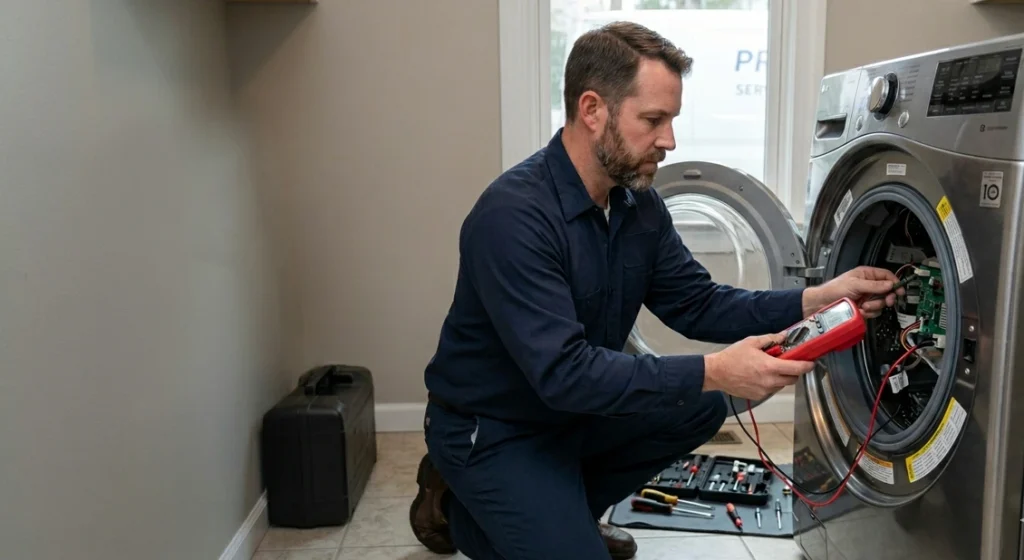
After the assessment, the technician identifies the specific failed component or components and provides a written estimate covering the parts needed, the labor required, and the total cost to complete the repair. This written estimate is the deliverable you are actually paying for. Without it, you are working from guesses, whether your own or a stranger’s over the phone, and guesses are a poor basis for deciding whether to spend $200 on a repair or $1,000 on a new appliance.
It is worth understanding that the diagnostic fee compensates the technician for expertise that took years to develop, not just for the physical act of walking through your door. A technician who can correctly identify that a refrigerator’s warm interior is caused by a failed start relay rather than a refrigerant leak, just from the sound the compressor makes on startup, is applying years of pattern recognition that most homeowners simply do not have.
How Much Does a Diagnostic Fee Cost in Naperville?
Diagnostic fee pricing varies by company, but there is a clear range that applies across most of the appliance repair industry, and Naperville falls comfortably within it with some local specifics worth knowing.
Nationally, diagnostic fees generally fall between $50 and $150, with many sources citing $50 to $100 as the most common range for standard residential visits. Forbes Home cost guides frequently note service call and diagnostic fees landing in the $100 to $200 range for HVAC specifically, with $150 being a common figure for air conditioning visits.
In the Naperville and broader DuPage County market, the higher cost of operating a service business compared to rural areas of Illinois pushes diagnostic fees toward the upper end of national norms. A flat fee around $99 is a common figure among appliance repair companies serving the area, and this aligns with industry-wide data showing $99 as a frequently used round number for diagnostic and service call charges.
Certain situations carry higher diagnostic fees regardless of location. Built-in appliances such as wall ovens, cooktops set into countertops, wine coolers, trash compactors, and ice machines often carry a higher diagnostic fee, sometimes $20 to $50 more than the standard rate, because these units take meaningfully longer to access and assess. If your appliance is built into custom cabinetry, expect the diagnostic fee to reflect that added complexity.
Timing also affects the fee. Emergency or after-hours calls usually cost more, and a diagnostic visit requested on a weekend or evening can carry a higher fee than the same visit scheduled during a Tuesday morning appointment.
Does the Diagnostic Fee Get Applied Toward the Repair Cost?
This is the single most important question to ask before booking any appliance repair appointment, and the answer genuinely varies by company, which is why asking matters.
Many reputable companies use what is sometimes called a credit-with-repair model. Under this structure, you pay the diagnostic fee at the time of the visit, but if you approve the recommended repair, that fee is subtracted from your total bill, effectively making the diagnostic free as long as you proceed. Sears Home Services, for example, structures its trip fee this way: the diagnostic fee is waived if you proceed with the repair, and you only pay the standalone fee if you decide not to move forward.
Other companies use a similar but inverted framing, where the diagnostic itself is advertised as free, but a fee applies only if you decline the recommended repair. The practical outcome for the homeowner is the same either way: proceed with the repair and the diagnostic effectively costs nothing extra, decline and you pay a flat fee for the technician’s assessment.
A smaller number of companies treat the diagnostic fee as fully non-refundable regardless of what you decide afterward. This is not necessarily a sign of a bad company, since the labor and travel involved in the visit are real costs either way, but it does mean the financial calculation is different. If you are comparing quotes from multiple Naperville providers, this single policy difference can be worth $75 to $150 depending on how the conversation goes.
The most useful step any Naperville homeowner can take before booking is simply asking: “If I approve the repair during this visit, does the diagnostic fee get credited toward the total cost?” A company with transparent pricing will answer this clearly and immediately, and the answer should match what is stated on their website or in their booking confirmation.
Why Paying the Diagnostic Fee Is Almost Always Worth It
It is tempting to view a diagnostic fee as an obstacle between you and a fixed appliance, especially when you suspect you already know what is wrong. In practice, the diagnostic fee is one of the most cost-effective parts of the entire repair process, for a few specific reasons.
The first reason is that appliance symptoms are frequently misleading. A refrigerator that is not cooling could be a failed compressor, a bad start relay, a clogged condenser coil, a failed evaporator fan, or simply a door seal that is no longer sealing. These failures range from a $100 fix to a $1,000 fix, and they produce nearly identical symptoms from the outside. Without a diagnostic, you are choosing a repair path based on a guess, and a wrong guess can mean paying for a part that was never the problem.
The second reason is that the diagnostic often reveals the fix is simpler and cheaper than expected. Many repairs turn out to be simple wiring issues, loose connections, or debris caught in a pump rather than a major component failure. A washing machine that will not drain might simply have a sock lodged in the pump, a five-minute fix that costs far less than the part replacement a homeowner might have assumed was necessary.
The third reason is that the diagnostic gives you the information needed for the repair versus replace decision, which is one of the most financially significant calls a homeowner makes about any major appliance. A widely used guideline in the industry is that if the repair cost exceeds roughly 50 percent of the cost to replace the appliance with a new unit, replacement often makes more financial sense, particularly for older appliances. You cannot apply that guideline without a real number, and the diagnostic fee is what gets you that number.
The fourth reason is safety. For gas appliances, electrical components, and refrigerant systems, a proper diagnostic identifies issues that are not safe to guess about. A gas range with an intermittent ignition problem, for example, could be a simple igniter replacement or could indicate a gas valve issue that poses a genuine safety risk. Only a hands-on diagnostic distinguishes between the two.
When a Diagnostic Fee Might Not Be Worth Paying
There are a small number of situations where paying a diagnostic fee makes less sense, and recognizing them helps you avoid spending money on information you do not actually need.
If the appliance is extremely old, already showing multiple signs of wear, and clearly past the point where any repair would be financially sound regardless of what the diagnostic reveals, you may already have enough information to move directly to replacement. A 16-year-old refrigerator that is making loud compressor noises, has a cracked door seal, and is not maintaining temperature is very likely past the point where a diagnostic changes the underlying decision.
If the problem is something you can identify and fix yourself with high confidence, such as a tripped circuit breaker, an unplugged appliance, a clogged lint filter causing a dryer to underperform, or a dishwasher that simply needs its filter cleaned, a diagnostic fee is unnecessary. These are situations where five minutes of your own troubleshooting can resolve the issue entirely.
If you already know, with certainty, that the appliance is going to be replaced regardless of what is found, for example because you are renovating the kitchen in the next month anyway, a diagnostic fee for a repair you have no intention of pursuing is money spent for information that will not change your plans.
For everything else, which is the vast majority of appliance failures, the diagnostic fee is a small, predictable cost that converts an uncertain situation into a clear decision.
How the Diagnostic Fee Fits Into Your Overall Repair Cost
Understanding where the diagnostic fee sits within the total cost of a repair helps set realistic expectations for the full bill, not just the initial visit.
Appliance repair in 2025 typically costs between $108 and $250 with an average around $179 for the labor and parts portion of common repairs, according to HomeAdvisor data. This figure represents the repair itself, separate from or inclusive of the diagnostic fee depending on the company’s billing structure. When the diagnostic fee is credited toward the repair, the $99 to $150 you pay at the start becomes part of that $108 to $250 total rather than an addition to it.
By appliance type, typical repair cost ranges (which may or may not include a separate diagnostic charge depending on the provider) generally run as follows: refrigerator repairs average $200 to $300, dishwasher repairs average $160 to $300, washing machine repairs range from $50 to $450 depending on the issue, dryer repairs typically run $100 to $400, and oven, range, and cooktop repairs span $100 to $500.
Labor rates, which make up the bulk of the repair cost beyond parts, generally run $50 to $150 per hour nationally, with some sources citing a range up to $250 per hour for specialized or high-end appliance work. In the Naperville market, labor rates tend toward the middle to upper portion of that range given regional cost factors.
The practical takeaway is that the diagnostic fee is rarely the dominant cost in an appliance repair. It is the gateway cost, the relatively small amount that determines whether the much larger repair or replace decision that follows is the right one.
Questions to Ask Before You Book a Diagnostic Visit in Naperville
A few minutes of questions before scheduling a diagnostic appointment can prevent confusion when the final bill arrives.
Ask what the diagnostic fee is and whether it is a flat rate or varies by appliance type. Built-in appliances, as noted earlier, sometimes carry a higher fee.
Ask directly whether the fee is credited toward the repair cost if you approve the work during the same visit, and get the answer in writing if possible, whether that is an email confirmation or a statement on the company’s website.
Ask whether there is an additional fee if the technician needs to return for a second visit because a part needs to be ordered. Some companies include the return trip in the original diagnostic fee, while others charge a second trip fee. This is a meaningful difference for repairs that commonly require ordered parts, such as control board replacements.
Ask what happens if the diagnostic reveals multiple issues. Some companies charge an additional diagnostic fee for each separate defect discovered, particularly in commercial or warranty contexts, though this is less common for standard residential appliance repair. Clarifying this upfront avoids surprises if your appliance turns out to have more than one problem.
Finally, ask whether the company provides the estimate in writing before any repair work begins. A written estimate that itemizes parts and labor separately, presented before work starts, is a hallmark of a transparent and trustworthy repair company. Companies that publish clear, predictable diagnostic fee policies and provide written estimates consistently earn better customer reviews and fewer disputes over final bills.
What a Naperville Diagnostic Visit Looks Like in Practice
For homeowners booking their first appliance repair appointment in Naperville, knowing what to expect on the day of the visit removes a lot of unnecessary anxiety.
When you call to schedule, you will typically be asked to describe the appliance, the brand and model if you have it handy, and a description of the symptoms. This information helps the technician anticipate what tools and common replacement parts to bring, which can sometimes mean a repair is completed in a single visit rather than requiring a return trip for ordered parts.
On the day of the appointment, most companies provide an arrival window rather than an exact time, often a two to three hour window. The technician will perform the assessment described earlier, which can take anywhere from 15 minutes for a straightforward issue to closer to an hour for something more involved like an intermittent electrical fault.
Once the technician has identified the issue, they will walk you through what they found in plain language, not just technical jargon, and provide a written estimate for the repair. At this point, you decide whether to proceed. If you do, in most cases the technician can complete common repairs on the same visit using parts carried on the service vehicle. If a specialized part needs to be ordered, the technician will schedule a return visit, typically within a few business days.
Naperville Appliance Fix provides diagnostic visits across Naperville, Bolingbrook, Aurora, Lisle, and Plainfield with transparent, upfront pricing and a written estimate before any repair work begins, so there are no surprises between the diagnostic and the final bill.
Diagnostic Fees and the Repair vs. Replace Decision
One of the most valuable outcomes of a diagnostic visit is the information it gives you for deciding whether to repair an appliance at all, particularly for older units where the answer is not obvious.
Once you have a written repair estimate from the diagnostic, compare that number against the cost of replacing the appliance with a new comparable model. If the repair cost is a small fraction of replacement cost, for example a $150 repair on a refrigerator that would cost $1,400 to replace, the decision is straightforward. If the repair cost starts approaching half of what replacement would cost, particularly on an appliance that is already 8 to 10 years old or more, replacement often becomes the more sensible long-term choice, since further repairs on an aging unit become increasingly likely.
This is exactly why the diagnostic fee earns its cost. A $99 diagnostic that reveals a refrigerator compressor has failed, with a repair estimate of $900 on a refrigerator that would cost $1,300 to replace and is already 11 years old, gives you the information to make a confident replacement decision rather than sinking $900 into a unit that may need another major repair within a year or two.
For more detailed guidance on weighing these factors for each major appliance type, see our repair or replace decision framework for Naperville homeowners.
Frequently Asked Questions
What is a diagnostic fee for appliance repair?
A diagnostic fee is the charge a repair company collects for a technician to travel to your home, inspect a malfunctioning appliance, identify the specific cause of the failure, and provide a written repair estimate. It covers the technician’s time, expertise, travel costs, and the use of diagnostic tools and equipment.
How much is a diagnostic fee for appliance repair in Naperville?
Most Naperville area appliance repair companies charge between $75 and $150 for a standard diagnostic visit, with $99 being a common flat rate. Built-in appliances such as wall ovens or units installed in custom cabinetry sometimes carry a higher fee due to the additional time required for access and assessment.
Do I have to pay the diagnostic fee if I do not get the repair done?
This depends on the company’s policy. Many companies charge the diagnostic fee regardless of whether you proceed, but credit that fee toward the repair cost if you approve the work. If you decline the repair, you typically pay only the standalone diagnostic fee. Always ask about this policy before booking.
Is the diagnostic fee applied to the repair cost?
At many reputable companies, yes. The diagnostic fee is credited toward your total repair bill if you approve the recommended work during or shortly after the visit. This means the diagnostic effectively costs nothing extra as long as you proceed with the repair through that same company. Confirm this policy directly when scheduling.
Is it worth paying a diagnostic fee for an old appliance?
In most cases, yes, because the diagnostic tells you whether the repair is financially worthwhile compared to replacement. The exception is when the appliance is already showing multiple clear signs of failure across several systems, in which case replacement may be the obvious choice regardless of what a diagnostic reveals.
Does Naperville Appliance Fix charge a diagnostic fee?
Naperville Appliance Fix provides transparent, upfront diagnostic pricing for appliance repair across Naperville and the surrounding DuPage and Will County communities. Contact the team directly through napervilleappliancefix.com for current pricing and to schedule a diagnostic visit for your specific appliance.