Electric Oven Bake Element Burned Out In Naperville is a common issue that can cause uneven baking, slow preheating, or no bottom heat at all. Learn how to identify a failed bake element, compare repair versus replacement costs, and determine when professional oven repair is the most cost-effective solution.
If you’ve noticed a visible gap or blistering on the coil at the bottom of your oven, or your food has stopped cooking evenly, here’s how to figure out exactly what you’re dealing with and what a fair price looks like before you call anyone.
How to Tell If the Bake Element Is Actually the Problem
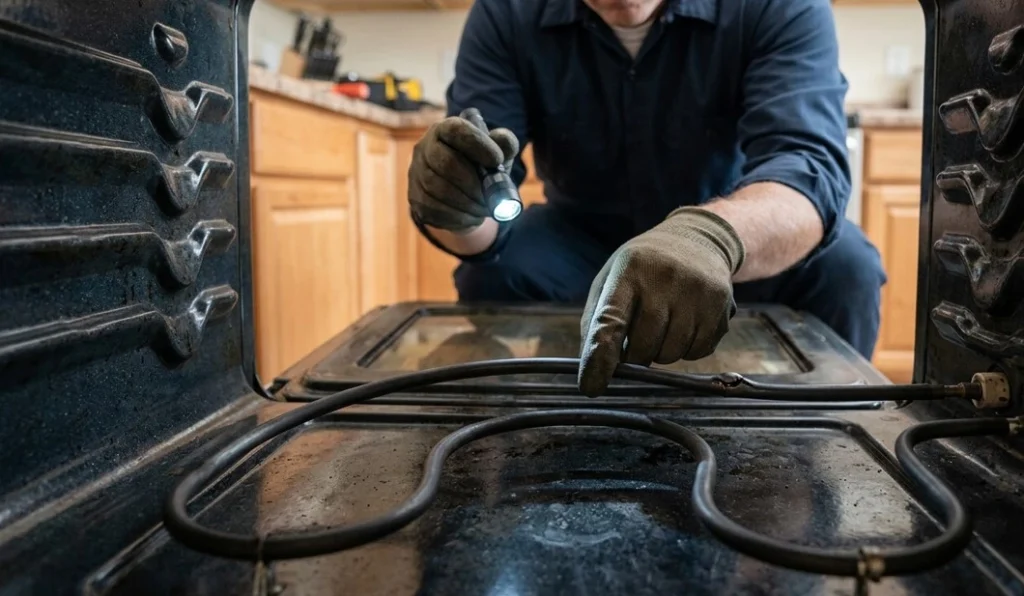
The bake element is the metal coil at the bottom of an electric oven’s interior, responsible for most of the heat during baking and roasting. A visual inspection is usually the fastest way to confirm it’s the culprit. Turn the oven on to bake and watch the coil. A healthy element glows a uniform bright orange within a few minutes. If you see a section that stays dark while the rest glows, a visible blister, crack, or a spot where the metal has separated entirely, that’s a clear sign the element has failed.
Other symptoms that point toward the bake element include food that’s cooking unevenly, with one area consistently underdone while another burns, a preheat cycle that’s noticeably slower than it used to be, or the oven not producing any bottom heat at all while the broil element on top still works fine.
It’s worth ruling out a couple of look alikes before assuming the element itself is dead. A tripped circuit breaker will stop the oven from heating entirely, and a failed thermostat or temperature sensor can produce similar symptoms without the element actually being damaged. A quick visual check for a visible break or blister in the coil is usually enough to tell the difference, since a genuinely failed element rarely heats at all, evenly or otherwise.
Why Bake Elements Burn Out in the First Place
Most bake elements fail simply from age and thousands of heating cycles, since the metal coil undergoes what’s often called thermal fatigue after years of expanding and contracting with each use. A sudden failure, rather than a gradual decline, can also point to a power surge, extended use at maximum temperature, or a buildup of grease and food debris creating a hot spot that weakens the coil at one specific point.
Regular oven maintenance can meaningfully extend an element’s working life. Wiping up spills before they bake onto the coil, avoiding excessive use of the self cleaning cycle, and giving the interior an occasional deep clean all reduce the kind of debris buildup that leads to premature failure.
What Bake Element Replacement Actually Costs
For a straightforward electric oven bake element replacement, Naperville homeowners can generally expect a total cost, including both the part and labor, in the range of 100 to 250 dollars. The part itself is usually inexpensive, often between 25 and 80 dollars depending on the brand and model, with labor making up the rest of the bill given that most technicians can complete the swap in under an hour once the oven is confirmed as the source of the problem.
A few things can push that cost higher. Luxury and specialty brands like Wolf, Viking, or Thermador tend to use custom engineered parts that cost more and may need to be special ordered, and wall ovens can run slightly higher than range style ovens due to more involved access and installation. If a technician discovers during diagnosis that the actual issue is a failed thermostat, thermal fuse, or control board rather than the element itself, those repairs run somewhat higher, generally in the 150 to 400 dollar range depending on the part.
Compare that to the cost of a new electric range, which typically starts around 600 dollars for a basic model and climbs well past 1,200 dollars for mid range and higher end options once delivery and installation are included. Even at the higher end of the repair cost range, fixing a bake element remains dramatically cheaper than replacing the entire appliance in nearly every case.
When Repair Makes Sense and When Replacement Is Smarter
A simple rule of thumb used by many appliance technicians is to compare the repair cost to roughly half the price of a new equivalent oven. A bake element replacement clears that bar easily on almost any oven, which is exactly why it’s one of the rare major appliance repairs that’s almost always worth doing regardless of the unit’s age, as long as the oven is otherwise in decent working condition.
The calculation changes if the bake element failure is happening alongside other issues. An oven that’s also showing a failing door seal, an unreliable control board, or is already past 15 to 20 years old, which is close to the upper end of a typical electric oven’s expected lifespan, might be better off replaced as a whole unit rather than patched one component at a time. Recurring repairs across multiple visits in a short period is generally a stronger signal to consider replacement than the age of the appliance by itself.
A Quick Word on Safety Before You Touch Anything
A bake element repair is mechanically simple, but it still involves exposed electrical connections inside a large kitchen appliance, and it’s worth treating that seriously. The oven needs to be fully disconnected at the circuit breaker, not just switched off at the control panel, before anyone touches the element or its wiring, since ovens draw significant current and a mistake here carries real electric shock risk.
The Consumer Product Safety Commission notes that unplugging an appliance or switching off its breaker before any repair work is one of the most basic and important steps in avoiding home electrical injuries, and that’s especially true for high draw appliances like ranges and ovens. If you’re not fully comfortable working around exposed wiring and 240 volt connections, this is a case where the labor cost of a professional repair buys real peace of mind along with the fix itself.
Getting a Fair, Accurate Quote
Because bake element repair is one of the more predictable and affordable appliance fixes, it’s a good category to get an upfront estimate on before committing to a service call, and a technician who’s seen the visible coil damage should be able to confirm both the diagnosis and the price quickly.
If your oven’s bake element has burned out or you’re seeing uneven baking and slow preheat times, our technicians at Naperville Appliance Fix can confirm the issue and provide a clear estimate before any repair begins. You can find more detail on how we handle electric and gas oven issues, including heating elements, thermostats, and control boards, on our oven repair page.
Frequently Asked Questions
How much does it cost to replace a bake element in Naperville? Most bake element replacements run between 100 and 250 dollars including parts and labor. The part itself typically costs 25 to 80 dollars, with the rest covering labor for a repair that usually takes under an hour.
How do I know if my bake element is actually broken? Turn the oven on to bake and look at the coil at the bottom. A healthy element glows uniformly bright orange. A visible gap, blister, or a section that stays dark while the rest glows is a clear sign the element has failed.
Is it worth repairing a bake element or should I just buy a new oven? Repairing is almost always the better choice financially. A bake element repair typically costs a fraction of what a new electric range costs, and it’s one of the few major oven repairs worth doing on almost any unit, regardless of age, unless the oven has other significant problems.
Can I replace a bake element myself? It’s mechanically one of the simpler oven repairs, but it requires disconnecting power at the circuit breaker, not just the control panel, before touching any wiring. If you’re not comfortable with that step, a professional repair is the safer option given the shock risk involved.
What if the oven still doesn’t heat after the element is replaced? That usually points to a different underlying issue, such as a failed thermostat, temperature sensor, or thermal fuse. A technician can test these components with a multimeter to confirm the actual cause rather than replacing parts by trial and error.
Sources referenced: the Consumer Product Safety Commission’s home electrical safety guidance on disconnecting power before appliance repairs, and the U.S. Department of Energy’s guidance on appliance lifespan and efficiency for context on when replacement outperforms repeated repairs.