
Standing water in the bottom of your Bosch dishwasher after a full cycle is one of the most common service calls we get in Naperville. A Bosch dishwasher not draining in Naperville homes is almost always tied to one of five culprits: a clogged filter, a blocked check valve, a kinked drain hose, a failed drain pump, or an air gap/garbage disposal blockage. This guide walks through each one so you can pinpoint the problem before deciding whether it’s a DIY fix or a job for a technician.
If you’ve worked through the filter, hose, and disposal knockout checks and the dishwasher still won’t drain, professional Naperville appliance repair can diagnose the pump and check valve with the correct parts on hand for same-day repair in most cases.
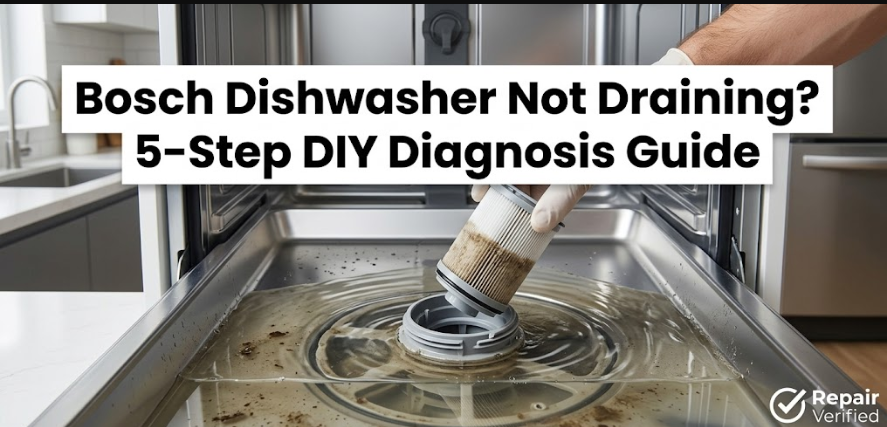
Table of Contents
Why Is My Bosch Dishwasher Not Draining?
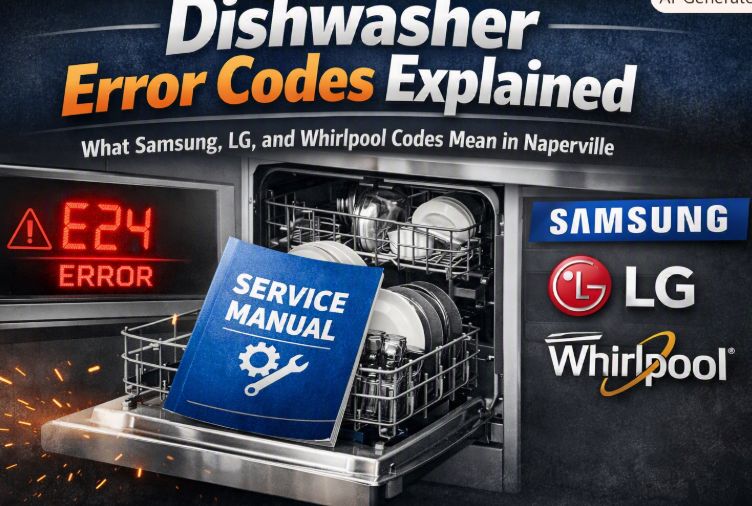
Most Bosch dishwashers stop draining because food debris has packed into the fine mesh filter at the bottom of the tub, or the check valve on the drain pump has stuck closed. Bosch models flash error code E24 or E15 when the drain path is obstructed or a leak is detected. Start by pulling the lower rack and inspecting the filter assembly — that single step resolves the issue in a large share of service calls before any tools are needed.
Step 1: Pull and Inspect the Filter Assembly
Bosch dishwashers use a self-contained filter system at the bottom of the tub, usually a coarse mesh cylinder that twists out counterclockwise. Ground-up food, glass shards, produce stickers, and bottle caps collect here and choke water flow to the drain pump.
- Remove the lower rack.
- Twist the filter cylinder a quarter turn and lift it straight out.
- Rinse it under hot water and scrub with an old toothbrush.
- Check the fine mesh screen underneath for tears — a torn screen lets debris reach the pump and causes repeat clogs.
If the filter was packed solid, that alone likely explains the standing water.
Step 2: Check the Drain Hose for Kinks or Blockages
The drain hose runs from the dishwasher to either the garbage disposal or an air gap fitting under the sink. A kink here is common after a new dishwasher install or after cabinet work, since the hose can get pinched behind the unit.
- Pull the dishwasher forward (unplug it first) and look for a sharp bend in the hose.
- Disconnect the hose at the disposal or air gap connection and blow through it, or run a plumber’s snake through it, to clear debris.
- Confirm the hose has a high loop before reaching the drain connection point — without one, dirty sink water can siphon back into the dishwasher instead of the appliance draining forward.
Step 3: Test the Check Valve
The check valve sits inside the drain pump housing and is designed to let water flow out but not back in. When it sticks shut, the pump runs but no water leaves the tub. When it sticks open, water siphons back in after the cycle ends. Either way, you’ll see standing water.
Accessing the check valve typically means removing the pump assembly, which involves detaching hose clamps and electrical connectors. This step crosses into technician territory for most homeowners, since reassembly has to be watertight or you risk a leak under the cabinet.
Step 4: Rule Out a Garbage Disposal Knockout Plug
If your dishwasher was connected to a new garbage disposal, or the disposal was recently replaced, this is worth checking before anything else. New disposals ship with a knockout plug inside the dishwasher inlet port that must be removed with a screwdriver and hammer before the connection is made. If it’s still in place, the dishwasher has nowhere to send its water.
Step 5: Listen for the Drain Pump Motor
Run a cycle and listen at the base of the unit during the drain phase.
- Humming with no water movement: the pump motor is running but the impeller is jammed or broken, or the check valve is stuck.
- No sound at all: the pump motor itself has likely failed, or the wire harness connector has come loose or corroded.
- Grinding or rattling: a foreign object, like a piece of glass, is caught in the impeller housing.
A failed drain pump motor is not a DIY replacement on most Bosch models, since it sits under the tub and requires disconnecting the sump assembly.
Common Bosch Error Codes Tied to Drainage
| Code | Meaning | Likely Cause |
|---|---|---|
| E24 | Drain fault | Clogged filter, kinked hose, weak pump |
| E15 | Water in base pan (leak sensor triggered) | Check valve stuck open, cracked sump |
| E22 | Circulation/filter fault | Debris blocking the circulation pump inlet |
If you’re seeing repeated E24 codes after cleaning the filter and hose, the drain pump or its check valve is the next likely point of failure.
Naperville-Specific Factors Worth Knowing
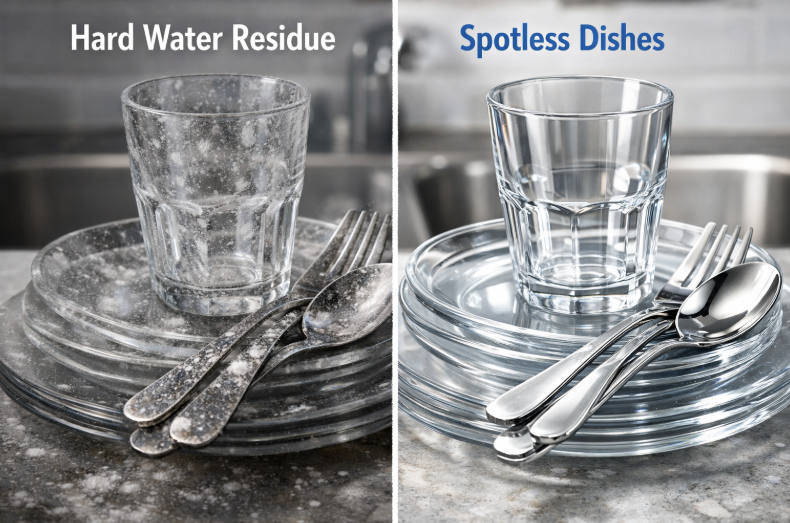
Naperville’s municipal water carries moderate hardness, and mineral buildup inside the check valve and drain hose accelerates over time compared to areas with softer water. Homes on well water in unincorporated areas around Naperville see this even faster, since sediment adds to the mineral scale. Running a monthly rinse-agent and hot water cycle helps slow this buildup, but it won’t reverse an already-clogged check valve.
When to Call a Technician
Filter cleaning and hose inspection are safe for most homeowners. Once the diagnosis points to the drain pump, check valve, or a circuit board fault behind an E15 or E22 code, professional diagnosis prevents a bigger problem — standing water that isn’t draining can back up into the base pan and trip the anti-flood float switch, or in worse cases, leak onto the subfloor.
If you’ve worked through the filter, hose, and disposal knockout checks and the dishwasher still won’t drain, professional Naperville appliance repair can diagnose the pump and check valve with the correct parts on hand for same-day repair in most cases.
For manufacturer-specific troubleshooting and part diagrams, Bosch’s own support documentation is a reliable reference: Bosch Home Appliances Support.
Frequently Asked Questions
Why does my Bosch dishwasher have standing water even after I ran it twice?
Running the cycle again doesn’t clear a mechanical blockage. If water remains after a second cycle, the filter, check valve, or drain pump has a physical obstruction or failure that a rinse cycle can’t fix.
Can I use vinegar or baking soda to fix a draining Bosch dishwasher?
These can dissolve light grease and mineral film, but they will not clear a physically clogged filter, a kinked hose, or a stuck check valve. Treat them as maintenance, not a repair for an active drainage failure.
Is it safe to run my dishwasher with an E24 or E15 code still showing?
No. Continuing to run cycles with standing water in the base pan risks the float switch triggering repeatedly or water finding its way past seals onto the subfloor. Clear the code’s root cause first.
Is it safe to run my dishwasher with an E24 or E15 code still showing?
No. Continuing to run cycles with standing water in the base pan risks the float switch triggering repeatedly or water finding its way past seals onto the subfloor. Clear the code’s root cause first.
How often should I clean my Bosch dishwasher filter to prevent this?
Once a month for average household use, and more often if you regularly wash cookware with heavy food residue or run the disposal infrequently, since backed-up disposal lines add strain to the dishwasher drain path.
Does a clogged garbage disposal cause my dishwasher not to drain?
Yes. Since most installations route the dishwasher drain hose through the disposal, a clogged or newly installed disposal with the knockout plug still in place will block dishwasher drainage entirely.
Will a repair technician need to replace the entire pump assembly, or just the check valve?
It depends on the failure point. Some Bosch models allow the check valve to be replaced separately; others require the full pump and sump assembly. A technician determines this during diagnosis by testing the motor and valve independently.
Pingback: Bosch Appliance Repair in Naperville IL | Expert Service
Pingback: Dishwasher Repair Naperville: Why the Top Rack Isn't Cleaning