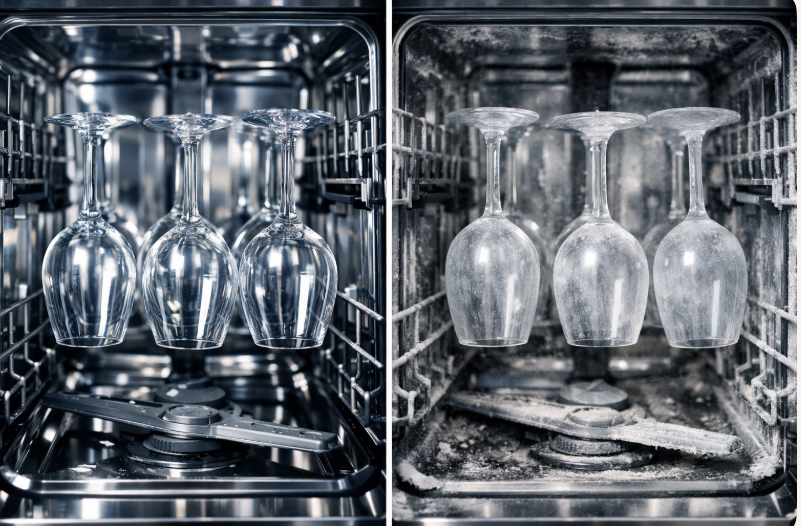
If your dishwasher leaves cloudy film on glasses, or your washing machine clothes come out stiff and dull — your appliances are probably not broken. Your water is the problem.
Naperville gets its water supply from Lake Michigan via the DuPage Water Commission, and that water arrives at your home with an average hardness of 8 grains per gallon (GPG). Anything above 1 GPG is technically hard water — so Naperville sits well into hard water territory. If you’re on a private well in the Naperville area, your water is likely even harder, averaging around 17 GPG from natural aquifers beneath the city.
Most homeowners spend hundreds of dollars replacing or repairing appliances without ever knowing water hardness was the root cause. This guide breaks down exactly what hard water does to your dishwasher and washing machine, how to spot the damage early, and what you can realistically do about it
What Actually Is Hard Water?
Hard water is water with high concentrations of dissolved calcium and magnesium minerals. These minerals create a range of problems, including buildup in plumbing and appliances, reduced effectiveness of soaps and detergents, and changes in the taste of water.
Water hardness is typically divided into five categories based on mineral concentration measured in grains per gallon: soft (0–3.5 GPG), moderate (3.5–7.0 GPG), hard (7.0–10.5 GPG), and very hard (above 10.5 GPG).
At 8 GPG, Naperville city water sits firmly in the “hard” range. Well water in the same area pushes into “very hard” territory. That matters because the harder the water, the faster scale accumulates inside your appliances — and the more aggressively it damages them.
How Hard Water Damages Your Dishwasher
The Scale Builds Up Where You Can’t See It
Inside a dishwasher, hard water deposits gradually accumulate on heating elements, spray arms, and the filter. This buildup narrows openings, restricts water flow, and makes it harder for the machine to maintain optimal cleaning temperature — reducing efficiency and increasing energy use. homeadvisor
The spray arms are the most vulnerable. Those small holes that jet water onto your dishes? Mineral deposits narrow them over time until the water pressure drops and dishes stop getting clean. You might run a second cycle thinking the dishwasher is struggling — and it is, but detergent isn’t the fix.
Your Energy Bill Goes Up, Not Just Your Repair Bill
Scale buildup on your dishwasher’s heating element acts as an insulator, making it harder to heat water efficiently. The dishwasher uses more energy because it must run longer to reach the desired temperature — and that extra strain on the heating element causes premature wear and potential breakdowns.
The cumulative annual cost for a household in a hard-water region — factoring in energy waste, more frequent repairs, and shortened appliance lifespans — is commonly estimated between $800 and $1,200 per year. That’s not a small number.
Dishes Come Out Cloudy and Spotted — That’s Not Normal
If your dishwasher leaves behind chalky residue or dull glassware, hard water is likely to blame. Hard water contains high levels of dissolved minerals that combine with detergent to form a film on dishes and buildup on appliance components, reducing performance. homeadvisor
Many Naperville homeowners assume their dishwasher is broken when they see this. In most cases, the machine works fine — the water chemistry is just working against it. If you need a professional diagnosis of what’s actually failing inside your dishwasher, our dishwasher repair service in Naperville can pinpoint whether it’s a hard water issue or a mechanical one.
Softened Water Extends Dishwasher Life by Up to 50%
Using softened versus hard water can increase the useful life of a dishwasher by 50%. That’s not a marginal improvement — that’s the difference between a 10-year appliance lasting 10 years versus only 5. homeadvisor
How Hard Water Damages Your Washing Machine
Mineral Deposits Clog the Parts You Never Think About
As hard water minerals build up on your machine’s pump, filter screens, and other moving parts, it needs to work harder to get clothes clean — shortening its lifespan by up to three years.
Hard water causes mineral buildup in the screens that filter water and in internal components, which eventually restricts water flow and can cause a breakdown. Even with a partial blockage, your machine works harder to clean laundry, and that added stress wears down the appliance more quickly.
Your Clothes Pay the Price Too
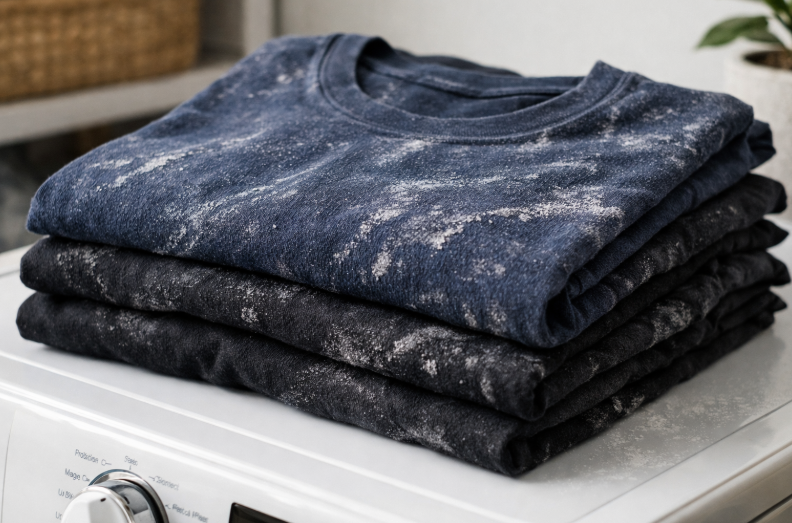
Hard water can be rough on clothes, causing colors to fade and fabrics to wear out faster. You may notice a chalky white substance left behind after washing that makes fabrics feel stiff and scratchy.
If your dark clothes consistently come out with white residue, that’s a mineral deposit — not a detergent problem and not a machine malfunction.
Hard Water Sabotages High-Efficiency Washers
If you’ve invested in a high-efficiency washing machine, you won’t get the same energy savings with hard water as you would with softened water. That also means higher electricity bills, especially if you find yourself running additional rinse cycles to remove residue from clothes.
A washer that costs more to run every cycle than it should, because of water hardness, defeats the entire purpose of buying an efficient machine.
Soap Scum Is Destroying Seals and Bearings
Washing machines deal with a particularly damaging effect: hard water reacts with soap to form a sticky residue called soap scum that coats drum seals and bearings, accelerating mechanical wear.
This is one of the more insidious forms of damage because it’s slow, invisible, and cumulative. By the time a bearing fails or a seal starts leaking, the machine has been deteriorating for months or years. If you’re already noticing leaks or unusual noise from your washer, get it checked before the damage compounds. Our appliance repair team in Naperville can assess whether hard water damage is behind those symptoms.
Signs Your Appliances Are Already Suffering From Hard Water Damage
You don’t need a water test to recognize the warning signs. Look for these:
On your dishwasher:
- Glassware comes out cloudy or spotty despite running a full cycle
- White chalky film on the interior walls of the dishwasher
- Dishes don’t feel clean even with fresh detergent
- The machine takes longer than usual to complete a cycle
- Spray arms feel clogged or water pressure seems weak during wash
On your washing machine:
- Clothes feel stiff, scratchy, or smell musty after washing
- White or grey residue on dark clothing
- The drum smells even after a hot wash cycle
- Pump or drain sounds louder than usual
- Machine vibrates more aggressively during the spin cycle
If you’re seeing three or more of these signs across either appliance, hard water has already done measurable damage. Catching it early is the difference between a maintenance fix and a full replacement.
What You Can Do About It Right Now
1. Run a Descaling Cycle on Your Dishwasher
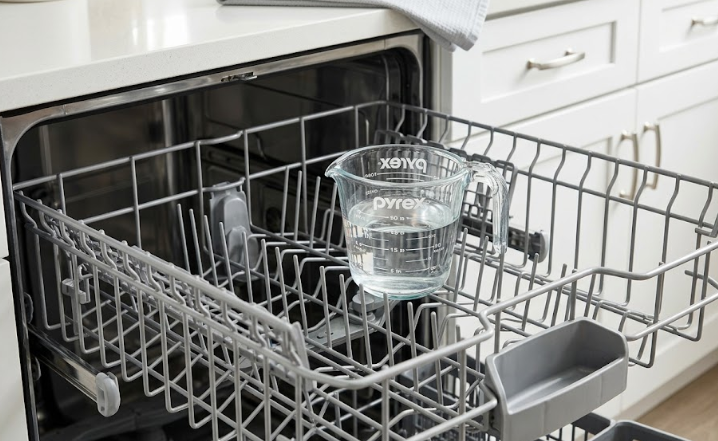
Place a cup of white vinegar on the top rack and run the hottest cycle your machine allows. This dissolves light mineral deposits on the interior walls and heating element. Do this monthly if you’re on Naperville city water and more frequently if you’re on a well.
For the filter specifically — pull it out, rinse it under hot water, and soak it in white vinegar for 20 minutes. Most Naperville homeowners have never done this and would be shocked at what comes out.
2. Clean Your Washing Machine’s Inlet Screens
Remove the inlet screens and clean them with a soft brush to clear mineral buildup that restricts water flow. These are small mesh filters at the back of the machine where the water hoses connect. Clogged screens are a direct result of hard water and a common cause of washing machines filling too slowly or not filling completely.
3. Switch to a Low-pH Detergent
Higher-quality detergents with a low pH help dissolve minerals in hard water, keeping clothes cleaner without the stiff, scratchy feel. This doesn’t fix the root problem, but it does reduce how aggressively minerals interact with your machine’s internal components.
4. Use a Washing Machine Cleaner Monthly
As part of a regular washing machine cleaning routine, use a cleaner that breaks up and clears away hard water buildup — specifically one formulated to break down hard water minerals to keep pumps and other parts clear. Affresh tablets are widely available and designed exactly for this.
5. Consider a Whole-Home Water Softener
This is the only solution that actually solves the problem at the source rather than managing symptoms. A whole-home water softening system costs between $500 and $6,000, depending on features and size. That sounds like a lot until you weigh it against the $800 to $1,200 in annual costs that hard water typically generates through energy waste, repairs, and shortened appliance lifespans.
Illinois law requires a licensed plumber to install water softening equipment, so this isn’t a DIY project — but the long-term math strongly favors the investment for most Naperville households.
When to Call a Naperville Appliance Repair Technician
Hard water maintenance can only go so far. If your dishwasher or washing machine has already reached the point where:
- The heating element has failed
- The pump motor is seizing or making grinding noises
- The water inlet valve is blocked beyond what cleaning will fix
- Control board errors are appearing consistently
- The machine is leaking at the seals or door gaskets
…then you’re past the maintenance stage and into repair territory. At that point, a professional inspection tells you clearly whether a targeted repair makes financial sense, or whether scale damage has compromised too many components for a repair to be worthwhile.
Our Naperville appliance repair technicians have seen the full spectrum of hard water damage across every major brand — Whirlpool, Samsung, LG, Bosch, Maytag, GE — and can give you an honest assessment of where your machine stands. You can also read our refrigerator repair guides to see how the same hard water problem affects your fridge’s ice maker and water dispenser.
FAQs: Hard Water and Appliance Damage in Naperville
Q: How hard is Naperville’s water exactly?
Naperville city water averages 8 grains per gallon (GPG) from Lake Michigan via the DuPage Water Commission. That places it firmly in the “hard” category — the threshold for hard water is 7 GPG. Residents on private wells in the Naperville area often see hardness levels of 17 GPG or higher, which is classified as very hard.
Q: Can hard water actually break my dishwasher or washing machine?
Yes — not overnight, but absolutely over time. Mineral scale clogs spray arms, coats heating elements, blocks inlet valve screens, and wears down seals and bearings. The machine works harder for every cycle, components fail earlier, and the overall lifespan shortens significantly. Most hard water appliance damage is gradual and invisible until something fails.
Q: My dishes look cloudy even when the dishwasher runs a full cycle. Is the dishwasher broken?
Not necessarily. Cloudy glassware and chalky residue on dishes is one of the clearest signs of hard water mineral film — not a malfunctioning machine. Try running a white vinegar cycle and cleaning the filter first. If the problem persists, the spray arms may be partially blocked with scale and need professional cleaning or replacement.
Q: My washing machine clothes come out stiff. Is that a detergent issue?
Usually not. Hard water minerals bind with laundry detergent and leave residue on fabric that makes it feel rough and stiff. Switching to a detergent formulated for hard water helps, but it addresses the symptom rather than the cause. The machine’s internal components are likely accumulating the same mineral deposits that are showing up on your clothes.
Q: Will a water softener actually protect my appliances?
Yes, and the data is clear on this. Softened water can extend a dishwasher’s useful life by up to 50% compared to running it on hard water. Washing machines, water heaters, and ice makers all benefit from the same reduction in scale accumulation. The upfront cost of a softener is typically recovered within a few years through lower energy bills, fewer repairs, and longer appliance lifespans.
Q: How do I know if my appliance damage is from hard water or something else?
Hard water damage follows a specific pattern: gradual performance decline rather than sudden failure, scale deposits visible on accessible components like filters and spray arms, and multiple appliances showing symptoms at the same time. Mechanical failures from manufacturing defects or normal wear tend to be more sudden and isolated to one component. If your dishwasher and washing machine are both underperforming, hard water is almost always a contributing factor in Naperville.
Q: Can I descale my appliances myself or do I need a technician?
Routine descaling — running vinegar cycles, cleaning filters, clearing inlet screens — is straightforward DIY maintenance that every Naperville homeowner can do. Where a technician becomes necessary is when scale has already caused internal component failure: a clogged inlet valve that won’t clear, a heating element that’s burned out, a pump that’s seized, or spray arms that are corroded beyond cleaning. At that stage, the symptoms won’t resolve without replacing the damaged parts.
Q: How often should I descale my dishwasher and washing machine in Naperville?
Given Naperville’s water hardness level, monthly maintenance is a reasonable baseline for most households. That means a monthly vinegar rinse in the dishwasher, a monthly washing machine cleaner tablet, and quarterly cleaning of inlet screens and filters. If you’re on a private well at 17 GPG, increase that frequency — your appliances are accumulating minerals significantly faster than city water households.
Have a dishwasher or washing machine that’s already showing signs of hard water damage? Contact Naperville Appliance Fix for a diagnostic visit. We serve all Naperville neighborhoods in the 60540 and 60565 zip codes.