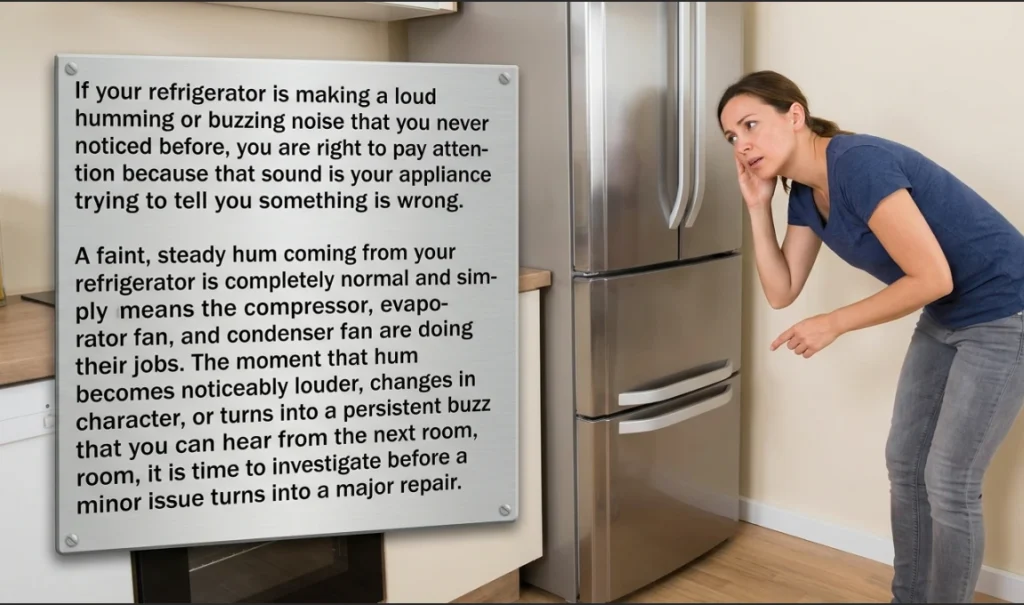
If your refrigerator is making a loud humming or buzzing noise that you never noticed before, you are right to pay attention because that sound is your appliance trying to tell you something is wrong. A faint, steady hum coming from your refrigerator is completely normal and simply means the compressor, evaporator fan, and condenser fan are doing their jobs.
If your refrigerator is making a loud humming or buzzing noise that you never noticed before, you are right to pay attention… If you’d rather leave the troubleshooting to the pros, our team offers fast, expert refrigerator repair in Naperville to get your kitchen running quietly again.
This guide covers every common cause of a loud humming or buzzing refrigerator, where the sound is coming from, what it means, and exactly what you can do about it.
Normal Refrigerator Sounds vs. Sounds That Mean Trouble
Before jumping to conclusions, it helps to understand what a refrigerator is supposed to sound like during normal operation.
A brief buzz as the compressor starts or while it runs to maintain temperature is completely normal. The condenser fan and the evaporator fan can also hum or buzz as they move air, and temperature settings influence how often these parts run. After you load a large grocery haul or leave the door open for a few minutes, the refrigerator works harder to recover its temperature, and you will naturally hear more noise until everything stabilizes.
What is not normal is a hum that is loud enough to hear clearly from another room, a buzz that runs constantly without cycling off, a vibrating sound that shakes nearby cabinet doors, or a noise that started suddenly and has not stopped since.
If your situation falls into that second category, keep reading.
Where Is the Noise Coming From? Start Here
The location of the sound is the fastest way to narrow down the cause. Before troubleshooting anything, stand near your refrigerator with background noise turned off and identify where the hum or buzz is loudest.
Sound coming from the back bottom of the refrigerator points toward the compressor or condenser fan. Sound coming from inside the freezer compartment points toward the evaporator fan or frost buildup. Sound during the ice making cycle points toward the water inlet valve or ice maker assembly. A vibration that seems to come from the whole unit points toward leveling issues or loose components.
Use that starting point to find your cause below.
1. Failing Evaporator Fan Motor
This is one of the most common sources of a loud hum or buzz inside the refrigerator, and it has a very reliable tell.
When the evaporator fan motor in the freezer behind the rear panel fails, it often generates a lot of noise, and this noise will be much louder when the refrigerator door is opened. That detail is the key diagnostic clue. If you open the freezer door and the humming immediately gets louder, the evaporator fan motor is almost certainly the problem.
The evaporator fan sits behind a panel at the back of the freezer compartment. Its job is to pull air over the cold evaporator coils and circulate that chilled air throughout both the freezer and the refrigerator section. When the motor begins to fail, its bearings wear out and it starts producing an audible hum or squeal that grows over time.
What to do: Unplug the refrigerator and remove the rear panel inside the freezer. Try spinning the fan blade by hand. If it does not spin freely or feels stiff and resistant, the motor has failed and needs replacement. A replacement evaporator fan motor for most common brands including Whirlpool, LG, Samsung, and GE costs between $150 and $300 installed by a Naperville technician.
2. Frost or Ice Buildup Around the Evaporator Fan
Sometimes the evaporator fan motor itself is fine, but ice buildup is causing the fan blades to strike frozen surfaces as they spin. The result is a loud buzzing, scraping, or humming noise coming from inside the freezer compartment.
If the evaporator fan is obstructed by excessive frost or ice, it will make a loud humming or buzzing noise as the spinning fan blade hits the ice or frost buildup. If the excessive frost and ice returns within a day or two after defrosting, the automatic defrost system needs to be troubleshot to permanently fix the problem.
This scenario is different from a motor failure because the noise often changes depending on how much ice is present and may be intermittent at first before becoming constant.
What to do: Unplug the refrigerator and remove the back panel inside the freezer. If you see a significant layer of frost or ice surrounding the fan area, defrost the unit completely by leaving it unplugged with the doors open for 24 to 48 hours. If the noise returns within a few days, the underlying defrost system, which includes the defrost heater, defrost thermostat, and defrost timer, needs professional diagnosis.
3. Dirty or Clogged Condenser Coils Overworking the Compressor
Dirty condenser coils can cause a noisy refrigerator. If these coils are coated with dust and dirt, the compressor has to work harder to cool the refrigerant, leading to louder operation.
The condenser coils are responsible for releasing heat from the refrigerant as it cycles through the system. When they are coated in dust, pet hair, and kitchen grease, that heat cannot escape efficiently. The compressor compensates by running longer and harder, which produces a louder and more continuous hum than normal.
This is one of the few causes of refrigerator noise that most homeowners can fix themselves at no cost other than their time.
What to do: Pull the refrigerator away from the wall and locate the condenser coils, which sit along the back or underneath the unit behind the front grille. Unplug the appliance. Use a refrigerator coil cleaning brush or a vacuum with a brush attachment to remove all accumulated debris. Restore power and give the compressor an hour to settle down to see if the noise reduces. Condenser coils should be cleaned at least once per year, or every six months if you have pets.
4. Failing or Struggling Compressor
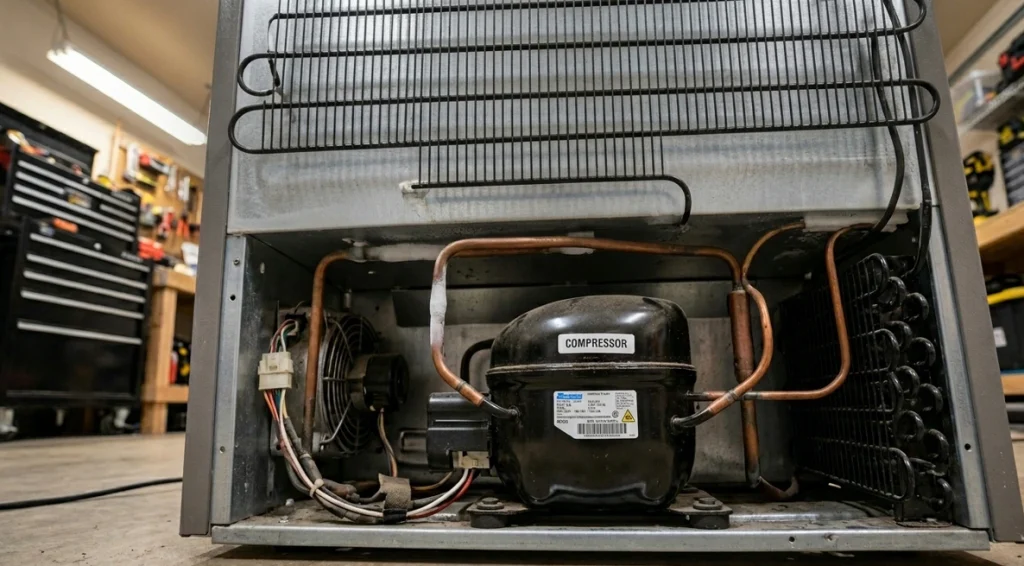
The compressor is the engine of your refrigerator. It compresses refrigerant and pushes it through the system to generate cooling. A healthy compressor produces a low, steady hum that you may notice during quiet moments at home but that never causes concern.
Abnormal compressor sounds, like loud humming, occur when the compressor never slows down or stops. If the compressor is continuously running more loudly, you may be dealing with a failed defrost system causing frost buildup that forces the compressor to work harder, or in more serious cases, the compressor itself may be failing.
A compressor that is failing often runs constantly, feels excessively hot to the touch at the back of the unit, and produces a hum that has changed in pitch or intensity compared to what you remember.
You may hear clicking or a rattling noise when the compressor is bad, along with loud buzzing or a knocking sound when the compressor shuts off, and you will likely notice cooling problems in both the fridge and freezer sections when the cause is a bad compressor.
What to do: Compressor diagnosis and replacement must be handled by a licensed appliance technician. Compressor replacement involves handling refrigerant, which is a regulated substance requiring professional certification. If your refrigerator is more than 10 years old and the compressor has failed, the cost of replacement often makes a new refrigerator the more sensible financial decision.
5. Faulty Water Inlet Valve
If the loud buzzing you hear tends to happen in short bursts, particularly at regular intervals or when the ice maker is running, the water inlet valve is a very likely culprit.
If the refrigerator has an ice maker but is not connected to a water supply, the water valve will make a buzzing or clicking sound as it tries to fill the ice maker. A restricted water filter or kinked supply line can also cause the inlet valve to buzz louder than normal during fill cycles.
The water inlet valve controls the flow of water from your home supply line into the ice maker and water dispenser. When the valve begins to fail, its internal plunger can jam or stick, creating a buzzing noise as it attempts to open and close. Low household water pressure can create the same symptom even on a valve that is still functional.
What to do: First, confirm the water supply line behind the refrigerator is not kinked and that the shutoff valve is fully open. Check whether your water filter is due for replacement, as a clogged filter restricts flow and forces the inlet valve to work harder. If none of those quick fixes eliminate the noise, the valve itself likely needs replacement, which a technician can complete in a single visit for around $100 to $200 including parts and labor.
6. Refrigerator Not Level
This cause is frequently overlooked because it seems too simple, but an unlevel refrigerator is a genuinely common source of vibration and buzzing noise that can sound surprisingly loud and alarming.
A refrigerator that is improperly leveled can cause vibrations that appear as loud humming sounds. Use a bubble level to check if the refrigerator sits evenly on the floor, and adjust the leveling legs at the bottom corners to ensure the unit is stable.
When a refrigerator is not sitting evenly on all four points of contact, the vibration from the compressor and fans transfers through the frame and into the floor or surrounding cabinetry. That amplified vibration can sound like a persistent buzz or hum that seems to come from everywhere at once.
What to do: Place a bubble level on top of the refrigerator and check it side to side and front to back. The refrigerator should be level side to side and slightly tilted back so that the doors swing closed naturally on their own. Adjust the front leveling legs by twisting them clockwise to raise that corner or counterclockwise to lower it. Check that the refrigerator is not touching the wall, a cabinet, or a neighboring appliance, as any contact point becomes a resonator for vibration.
7. Ice Maker Assembly Problems
Issues like a stuck ice cube in the ice maker ejection arms can cause gears in the ice maker to slip and buzz. If the ejection motor is humming even though no ice cubes are stuck in the ejection arms, a technician will likely need to replace the ice maker assembly.
The ice maker goes through a mechanical cycle to freeze water, eject cubes, and refill. When any part of that cycle is interrupted, including a stuck cube, a failing mold heater, or a worn tray drive motor, the assembly produces an audible hum or grinding sound as it struggles to complete the cycle.
What to do: Listen carefully near the ice maker area to confirm the timing of the noise aligns with ice making cycles. Open the ice maker compartment and look for any ice that has bridged or jammed in the ejection arms. Clear any obstruction with a wooden utensil and warm water. If the noise persists with no visible obstruction, the ice maker motor or assembly needs professional evaluation.
8. Loose Components, Drain Pan, or Vibrating Panels
Loose parts like screws, panels, or the drain pan can vibrate and produce a humming noise. Inspecting the rear and bottom of the refrigerator for loose components, tightening screws, securing the drain pan, and ensuring all panels fit snugly can resolve this issue.
This is another cause that costs nothing to check and fix. The drain pan sits underneath the refrigerator near the compressor and collects condensation that evaporates over time. If the pan is slightly out of position, it rattles against the frame every time the compressor runs. Similarly, rear access panels and internal components can work loose over years of vibration.
What to do: Pull the refrigerator away from the wall and visually inspect the bottom and rear. Locate the drain pan and make sure it sits flat and secure in its bracket. Check any visible screws on rear panels and tighten anything that has worked loose. This five-minute check has resolved many noise complaints that homeowners assumed required a service call.
How to Quickly Diagnose the Source of the Noise
Work through these questions in order to point yourself toward the right cause:
Does the noise get louder when you open the freezer door? That points directly to the evaporator fan motor or frost buildup around the fan blades.
Does the noise come in short bursts at regular intervals and seem related to the ice maker running? That points to the water inlet valve or ice maker assembly.
Is the noise constant and coming from the back bottom of the refrigerator? That points to the compressor or condenser fan.
Does the whole refrigerator seem to vibrate or shake? Check leveling legs and loose components first.
Did the noise start soon after you moved the refrigerator or rearranged the kitchen? Check whether the unit is touching any adjacent surface.
What a Bad Compressor Sounds Like vs. a Bad Evaporator Fan
Homeowners frequently confuse these two causes because both produce a hum. Here is how to tell them apart.
A failing evaporator fan produces a hum or squeal that is loudest inside the freezer compartment and gets noticeably louder when you open the freezer door. The compressor may still be running normally, and the refrigerator may still be cooling adequately at first.
A struggling compressor produces a hum or buzz that comes from the back bottom of the unit, does not change when you open doors, runs continuously without cycling off, and is accompanied by reduced cooling in both the freezer and refrigerator sections.
Repair Cost Estimates for Naperville Homeowners
Evaporator fan motor replacement: $150 to $300 including parts and labor.
Defrost system repair covering the heater, thermostat, or timer: $100 to $300.
Water inlet valve replacement: $100 to $200.
Condenser coil cleaning performed by a technician: $75 to $100 as part of a service call.
Compressor replacement: $300 to $700 or more depending on the brand and model.
The cost for a technician to perform a diagnosis and complete necessary repairs for refrigerator noise issues typically ranges from $150 to $400, depending on the part that needs service.
As a general guideline, if the repair cost exceeds half the price of a comparable new refrigerator and the unit is more than 10 years old, replacing rather than repairing is usually the smarter financial decision.
When to Call a Naperville Appliance Repair Technician
Some refrigerator noise problems are genuinely DIY friendly. Cleaning condenser coils, leveling the unit, clearing a stuck ice cube, and securing a loose drain pan are all tasks any homeowner can handle safely.
These situations, however, require a professional:
The evaporator fan motor or condenser fan motor needs replacement. Accessing these components properly and matching them to your specific model requires training and the right parts.
The compressor is making noise. Compressor work involves refrigerant handling, which is legally restricted to certified technicians.
The defrost system needs component testing and replacement. This requires a multimeter and knowledge of electrical testing procedures.
The water inlet valve needs replacement and the water supply line needs to be disconnected safely.
The noise is accompanied by cooling problems. When two symptoms appear together, the underlying cause is more serious and needs professional diagnosis.
If you are in Naperville, Aurora, Bolingbrook, Downers Grove, or anywhere in DuPage County and your refrigerator is making a loud humming or buzzing noise that you cannot resolve with the steps above, a local certified technician can typically diagnose and repair the problem in a single visit.
How to Prevent Refrigerator Noise Problems in the Future
Clean the condenser coils every 12 months, or every 6 months if you have pets. This one habit prevents the compressor from overworking, which is the root cause of several noise issues.
Check the leveling legs annually, especially after any kitchen renovation or if the refrigerator has been moved.
Replace the water filter on schedule, typically every six months. A clogged filter stresses the water inlet valve and ice maker system.
Listen to your refrigerator regularly during quiet moments. Catching a small change in sound early almost always means a less expensive repair than waiting until the noise becomes severe.
Inspect door gaskets every six months. A leaking gasket allows warm air in, forces the compressor to run constantly, and contributes to evaporator frost buildup that eventually causes fan noise.
Summary
A refrigerator making a loud humming or buzzing noise is almost always traceable to one of eight causes: a failing evaporator fan motor, frost buildup striking the fan blades, dirty condenser coils overworking the compressor, a struggling compressor, a faulty water inlet valve, an unlevel unit, ice maker problems, or loose components vibrating against the frame.
Start by identifying where the noise is loudest, then work through the checks in this guide from the simplest fixes to the more complex. Most noise problems are caught and resolved affordably when addressed early. The ones that are ignored tend to become cooling failures that cost significantly more to fix.
If you are in Naperville and your refrigerator is making a loud humming or buzzing noise that simple troubleshooting has not resolved, contact Naperville Appliance Fix for same-day diagnosis and repair.
If you need fast, dependable appliance repair in Naperville, our team proudly serves Naperville, Aurora, Bolingbrook, Downers Grove, Lisle, Wheaton, and all surrounding DuPage and Will County communities.
For homeowners searching for fast and reliable appliance repair in Salem, Oregon, addressing refrigerator humming or buzzing noises early can help prevent costly compressor and cooling system failures.