The direct answer: Naperville homeowners consistently get faster service, more transparent pricing, greater accountability, and better long-term results by working with a local appliance repair company rather than a national chain. The difference is not marginal. It shows up in scheduling, communication, technician expertise, and total cost, every single time an appliance breaks down.
The Promise vs. The Reality of National Chain Appliance Repair
National appliance repair chains are built on the promise of scale. The pitch is straightforward: a large company with technicians across the country can respond quickly, has access to more parts, and offers consistent, standardized service backed by a well-known brand. For many homeowners in Naperville, that promise sounds reassuring, especially in a moment of appliance stress.
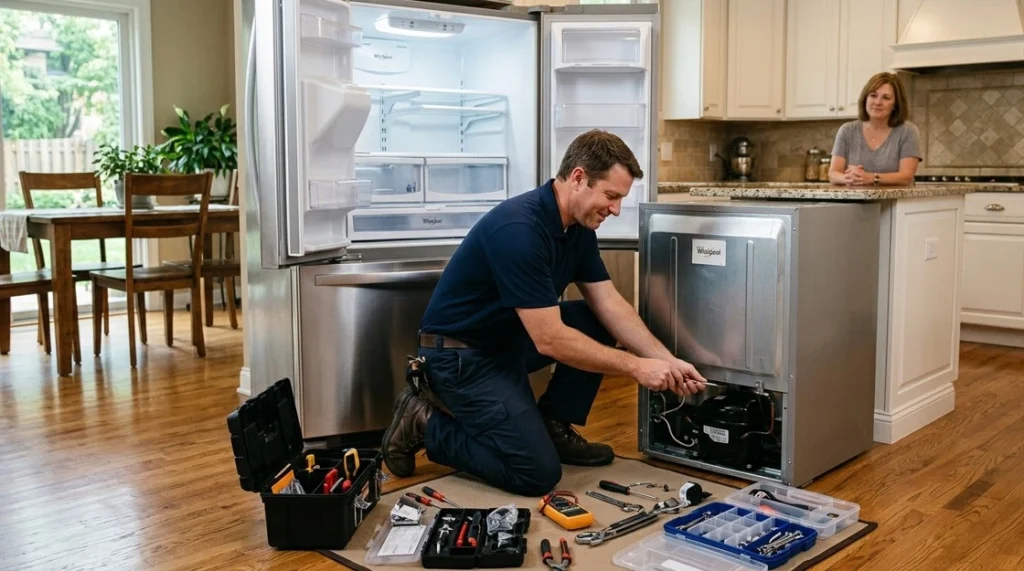
The reality, documented in thousands of verified customer reviews across platforms like Trustpilot and ConsumerAffairs, rarely matches the marketing. A homeowner in an Illinois suburb who calls a national chain for a refrigerator repair is not connecting with a local technician who knows DuPage County. They are entering a customer service queue managed by an AI scheduling system, waiting for a technician dispatched from a regional territory that may cover multiple counties, and hoping that the appointment scheduled ten days out actually holds.
An ABC7 Chicago investigative report published in late 2025 documented the experience of multiple Illinois residents who paid monthly premiums to Sears Home Services, only to wait months for completed repairs, experience repeated last-minute cancellations, and discover that the national company’s AI phone system provided no path to speak with a real human being when things went wrong. One Algonquin resident cooked without a working oven for a year and a half while the warranty company processed claim after claim without resolution. A Rosemont homeowner waited four months and endured more than a dozen canceled appointments before receiving a reimbursement check. These are not outlier stories. They reflect the structural tension between a national chain’s cost optimization model and the individual homeowner’s need for a working appliance by tomorrow.
Understanding why local consistently outperforms national requires looking at six specific areas where the differences are most pronounced.
Reason 1: Response Time That Fits Real Life in Naperville
When a refrigerator stops cooling on a Thursday evening in Naperville, the question is not whether to call for repair. The question is how soon a qualified technician can arrive, diagnose the problem, and fix it. For a family with children, that window is measured in hours, not weeks.
Local appliance repair companies operating in Naperville work within the community they serve. Technicians live in or near DuPage County, which means drive times from dispatch to your door are measured in minutes rather than the cross-county logistics that national chains manage. Same-day and next-day appointments are a standard offering from local providers because they have the scheduling flexibility that a regional dispatch center cannot replicate.
National chains, by contrast, build schedules across entire geographic territories. A technician assigned to your area may also cover Bolingbrook, Aurora, and Joliet on the same day. When routes change, parts are delayed, or a previous job runs long, your appointment is the one that gets rescheduled. That rescheduling triggers another call to a national customer service line, another AI phone tree interaction, and another lost half-day waiting at home for someone who may or may not show.
The full appliance repair services available at Naperville Appliance Fix are built around the scheduling reality of Naperville households. Same-day appointments exist because the technicians serving your neighborhood are actually in your neighborhood, not in a regional dispatch center managing a three-county territory.
Reason 2: You Talk to a Person, Not a Phone Tree
This is a small thing that becomes enormous the moment something goes wrong.
When your washer stops mid-cycle with a full load of wet laundry inside and you call a local appliance repair company in Naperville, a person answers. That person can tell you immediately whether they have availability today or tomorrow, whether they carry the parts most commonly needed for your brand and model, and what you can expect to pay for the diagnostic visit. The entire exchange takes three minutes.
When the same homeowner calls a national chain, they enter an automated system designed to manage volume rather than solve individual problems. AI phone assistants ask for account numbers, serial numbers, and problem descriptions before routing calls through multiple departments. Hold times extend. Transfer loops repeat. When a technician appointment is finally confirmed, the confirmation arrives by text from a system that cannot answer follow-up questions.
The disconnect grows worse when things go wrong. Canceled appointments, delayed parts, and disputed claims require human resolution. National chains increasingly handle these situations through AI escalation pathways that leave homeowners with nowhere to direct their frustration. The ConsumerAffairs review record for major national repair chains in 2025 and 2026 is filled with homeowners describing hour-long phone calls that produced no outcome, no accountability, and no repaired appliance.
Local companies operate on a different accountability model entirely. The person who answers the phone often knows the technician who will come to your home. In some cases they are the same person. That continuity of accountability produces a fundamentally different service experience, and it is one of the primary reasons that local appliance repair businesses earn repeat customers and referrals in communities like Naperville at rates that national chains cannot match.
Reason 3: Technicians Who Know Your Neighborhood’s Appliances
Appliance repair expertise is not purely generic. The specific brands, models, and failure patterns that a technician encounters repeatedly in a given region shape their diagnostic speed and accuracy in ways that centralized training programs cannot fully replicate.
In Naperville and the broader DuPage County market, certain appliance brands dominate. Homes in White Eagle, Hobson West, and Cress Creek were built during eras when GE, Whirlpool, Kenmore, and KitchenAid were the dominant brands in the market. More recently constructed homes near Route 59 and the newer developments along the Fox River corridor have seen an influx of LG, Samsung, Bosch, and Frigidaire appliances. A local technician who has been working in Naperville for several years has encountered the specific failure patterns of these brands in this climate, with this water hardness, and in homes of these construction vintages.
That accumulated regional knowledge directly speeds up diagnosis. A local technician who has replaced the ice maker motor on a specific LG French-door model eight times in the past year does not need to spend forty-five minutes consulting a service manual to diagnose and repair your ninth. The diagnostic visit is faster, the correct part is more likely to be on the truck, and the first-visit completion rate is higher. This is not a small advantage. First-visit repair completion is one of the most significant drivers of total appliance repair cost, because every return visit adds labor charges, scheduling time, and the ongoing cost of the broken appliance impacting your household.
For washer repair in Naperville specifically, regional expertise matters because water hardness in DuPage County creates specific scale and mineral deposit patterns in washing machine components that a technician working across multiple water districts may not immediately recognize as the root cause of a failure. Local knowledge translates directly into faster, more accurate repairs.
Reason 4: Transparent Pricing Without Structural Upsells
National chains carry overhead costs that local companies do not. Corporate office staff, regional management layers, national marketing budgets, call center infrastructure, and franchise fees all need to be covered by the revenue each service call generates. That overhead pressure does not disappear; it gets distributed across customer invoices in ways that are not always visible before the technician arrives.
The diagnostic fee structure at national chains is designed to capture revenue regardless of whether a repair is completed. A technician arrives, performs a diagnosis, and presents a repair estimate. If the homeowner declines the repair, they still owe the diagnostic fee, which at some national chains runs between $100 and $150 as a standard service call charge. Some homeowners report being charged diagnostic fees even when the technician could not identify the problem or lacked the parts to complete the repair.
Local appliance repair companies carry lower overhead and derive their business sustainability from repeat customers and community referrals rather than volume-driven transaction margins. That business model produces pricing that is more directly tied to actual labor and parts cost, fewer surprise line items, and a greater willingness to give honest repair-versus-replace advice when a repair cost approaches or exceeds the value of the appliance.
According to ConsumerAffairs appliance repair industry data, the appliance repair industry in the United States had a revenue of $6.3 billion in 2023, shared among a little over 60,000 businesses. That highly fragmented structure means independent local repair shops compete directly with national chains on a level playing field, and in communities where reputation matters, local companies win on pricing transparency consistently.
For refrigerator repair in Naperville, the difference in total invoice cost between a local company providing an upfront estimate and a national chain billing at a post-service structure can run $75 to $200 on a typical repair, before any premium service fees or warranty surcharges are applied.
Reason 5: Accountability That Does Not Evaporate After the Invoice
Every reputable appliance repair company, whether local or national, offers a warranty on parts and labor. The difference is in what happens when that warranty needs to be invoked.
If a national chain completes a repair on your oven and the same problem returns three weeks later, the process of getting it covered under the workmanship warranty involves calling the national customer service line, navigating the appointment system again, waiting for a technician from the same regional pool that may or may not have availability this week, and hoping the second technician agrees with the first technician’s diagnosis. The accountability chain runs through multiple layers of company infrastructure before it reaches the person who actually worked on your appliance.
If a local Naperville company completes the same repair and the problem returns, you call the same number you called the first time, speak with the same person, and schedule with the same technician or their colleague who has access to the original service record. The resolution path is short, direct, and personally accountable in a way that national chain structures cannot match.
This accountability dynamic is not abstract. It is why Yale Appliance, one of the most respected appliance retailers and repair providers in the Northeast, has documented the failure of the national warranty and third-party repair chain model in concrete terms. As they noted, when a store sells you an extended warranty, the store has already collected payment and the warranty provider has already resold the repair job to a low-bid contractor. Yale Appliance’s analysis of extended warranty chains found that no one in that chain feels responsible for solving your problem, which is exactly why homeowners end up waiting weeks for parts and wondering why they bought the warranty in the first place. Local companies have no such diffusion of responsibility. Your repair, your relationship, your accountability.
Reason 6: Safety Standards and Certified Technician Expertise
Appliance repair is not a risk-free service category. Gas appliances, high-voltage electrical systems, refrigerant-handling procedures, and sealed compressor systems all require certified technicians who understand both the technical requirements and the safety standards governing their work.
The NFPA’s safety standards for gas appliances and electrical systems set the baseline for what constitutes a safe repair on equipment that, if improperly serviced, can create fire hazards, gas leak risks, and carbon monoxide exposure in residential settings. Certified local technicians serving Naperville operate under Illinois contractor licensing requirements and carry general liability insurance and workers’ compensation coverage, which means any damage caused during a repair is covered, and any injury on your property is the company’s responsibility rather than yours.
National chains vary significantly in how they verify the credentials of the contractors dispatched through their networks. In some cases, the national brand is essentially a scheduling intermediary connecting homeowners with independently contracted technicians whose individual training and certification levels are not uniformly maintained. A homeowner calling a well-known national brand name may receive a technician with excellent credentials or one with minimal verifiable qualifications, and the brand’s marketing materials do not make that distinction clear.
For oven and range repair in Naperville, where gas igniters, valve connections, and burner assemblies require certified gas appliance handling, knowing the exact credentials of the technician entering your home matters in ways that national chain scheduling systems are structurally unable to guarantee.
Reason 7: Supporting the Naperville Economy You Are Already Part Of
This reason matters less to some homeowners than others, but for those who think about where their spending goes, it carries real weight.
When a Naperville homeowner pays a local appliance repair company for a service call, that revenue stays in DuPage County. It pays the wages of technicians who live in Naperville, Bolingbrook, and the surrounding communities. It supports a business owner who shops at local stores, whose children attend District 203 or District 204 schools, and who contributes to the tax base that funds the infrastructure Naperville homeowners use every day. The economic multiplier effect of local spending is well established in small business economic research: money spent at locally owned businesses recirculates through the community at higher rates than money spent with national chains, where revenue is consolidated at corporate headquarters in another state.
National chain service revenue flows toward corporate cost structures, national marketing campaigns, and shareholder returns. The technician dispatched to your home may live locally, but the economic structure of the transaction does not benefit the local community in the same way that a genuinely local business does.
For a community like Naperville, which has consistently ranked among the best places to live in Illinois and in the United States precisely because of its strong community institutions and local economic vitality, choosing local businesses when quality and value are competitive is not just a sentimental preference. It is a practical contribution to the conditions that make Naperville worth living in.
What to Look for in a Local Naperville Appliance Repair Company
Choosing local does not mean accepting any local option without scrutiny. The quality of local companies varies, and Naperville homeowners deserve to know what separates a genuinely reliable local provider from one that simply operates in the area.
Look for companies that provide written upfront estimates before any work begins. Any company that cannot or will not give you a clear estimate before the repair starts is not operating with the pricing transparency that a reputable local provider should offer.
Verify that the company holds current Illinois contractor licensing and carries both general liability insurance and workers’ compensation coverage. This is not bureaucratic formality. It is the difference between your homeowner’s insurance covering a repair-related incident and the repair company’s insurance covering it.
Ask specifically about the warranty on parts and labor. A 90-day parts and labor guarantee is the minimum standard for reputable Naperville appliance repair providers. Companies confident in their work typically offer longer warranty windows because they expect their repairs to last.
Check for brand-specific certifications on the appliances you own. Technicians certified to work on LG, Samsung, Whirlpool, GE, KitchenAid, Bosch, and Frigidaire have completed manufacturer-recognized training programs that validate their expertise on those specific platforms. For high-end brands like Sub-Zero, Viking, or Thermador, certification is particularly important because proprietary components and sealed systems require brand-specific knowledge.
Ask about parts availability before scheduling. A local company that stocks common parts for the brands prevalent in Naperville homes will complete your repair in a single visit at a far higher rate than one that orders everything through a distributor, adding days to your repair timeline.
The Comparison That Matters Most
National chains win on marketing. They have larger budgets, more recognizable brand names, and national advertising reach that gives them top-of-mind awareness when a homeowner searches for appliance repair help.
Local companies win on everything else. Faster scheduling. Direct human communication. Regional appliance expertise. Transparent pricing. Personal accountability. Safety credential verification. And a direct economic relationship with the community where both the homeowner and the business actually live.
For Naperville homeowners, the calculus is not complicated. The next time an appliance breaks and you need it fixed quickly, correctly, and at a fair price, the choice between spending thirty minutes navigating a national chain’s AI phone system and scheduling two weeks out versus calling a local technician who answers in three rings and can be at your home tomorrow is not really a choice at all.
Naperville Appliance Fix serves the Naperville community with same-day and next-day appointments, certified technicians, upfront pricing on all major appliance brands, and a parts and labor warranty that stands behind every repair. Schedule your service call today and find out what appliance repair in Naperville is supposed to feel like.
Naperville Appliance Fix serves homeowners across zip codes 60540, 60563, 60564, 60565, 60566, and 60567. Call (630) 467-7265 for same-day and next-day service on all major appliance brands including LG, Samsung, Whirlpool, GE, KitchenAid, Bosch, Frigidaire, Sub-Zero, Viking, and Thermador.