
What Is a Refrigerator Compressor and Why Does It Matter?
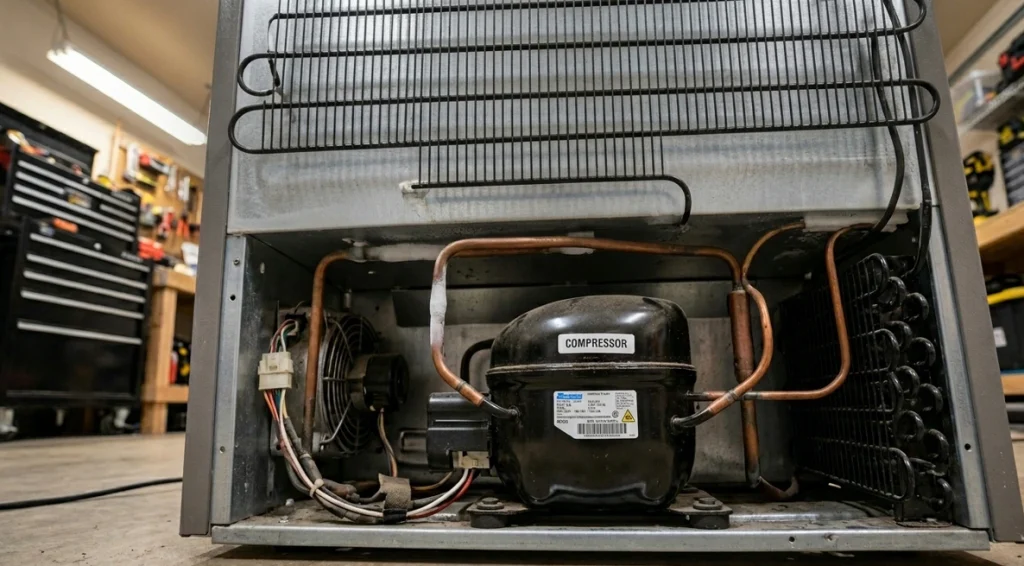
Before getting into the warning signs, it helps to understand what the compressor actually does. Think of it as the heart of your refrigerator. It pumps refrigerant through a closed loop that includes the evaporator coils and condenser coils, transferring heat out of the interior so that food stays cold and safe.
Every time your refrigerator reaches the right temperature, the compressor shuts off. When the temperature rises again, it kicks back on. This cycling behavior is completely normal. What is not normal is when the compressor cannot complete a cycle, runs nonstop, overheats, or fails to start at all. At that point, the entire refrigeration cycle breaks down, and food begins to spoil.
Brands like Samsung, LG, Whirlpool, GE, and Maytag all rely on variations of this same fundamental technology, whether it is a traditional piston compressor, a linear compressor, or a digital inverter compressor. The failure symptoms are largely the same across all of them, though some brands have had more documented issues than others.
How Long Should a Refrigerator Compressor Last?
Understanding compressor lifespan puts the warning signs into better context. On average, a refrigerator compressor lasts anywhere from 10 to 15 years under normal household conditions. With proper maintenance and favorable usage patterns, some compressors push well beyond that range.
Top-freezer models tend to outlast French door and side-by-side configurations because they put less mechanical stress on the cooling system. Built-in and high-end refrigerators often cross the 20-year mark when properly serviced.
Brand choice also plays a role. Whirlpool, Maytag, and GE have consistently earned strong longevity ratings, often reaching 13 to 19 years of service. LG’s linear compressor, which the company backs with a 10-year warranty, is engineered to reduce internal friction and extend operational life. Samsung’s digital inverter compressor has undergone extensive third-party durability testing, with certified results showing it can operate reliably for over two decades under optimal conditions.
If your refrigerator is older than 8 to 10 years and you are noticing any of the symptoms below, compressor wear is a realistic possibility. If it is under 5 years old and showing these signs, a faulty start relay, refrigerant issue, or electrical problem may be the actual culprit, and the compressor itself may still be salvageable.
8 Clear Signs Your Refrigerator Compressor Is Failing
1. Your Refrigerator Is Not Cooling Properly
This is almost always the first and most obvious sign. If food that used to stay fresh for a week is spoiling in a few days, if your drinks never feel properly cold, or if specific sections of the fridge feel warmer than others despite unchanged temperature settings, the compressor may not be doing its job.
A healthy compressor efficiently circulates refrigerant through the evaporator coils, pulling heat out of the interior. When it begins to fail, refrigerant circulation slows down or stops, and the internal temperature starts climbing. Use an appliance thermometer to check the actual temperature inside your fridge. A properly working refrigerator should maintain between 35°F and 38°F (1.7°C to 3.3°C), while the freezer compartment should hold between 0°F and 5°F (minus 17.8°C to minus 15°C). Anything consistently above these thresholds is a problem that deserves attention.
2. Strange or Unusually Loud Noises Coming from the Back
A gentle hum is the normal soundtrack of a working refrigerator. The moment you start hearing grinding, rattling, clicking, or loud buzzing, pay attention.
A clicking sound that repeats every few minutes often means the compressor is trying to start but cannot complete the startup cycle. Grinding or clacking noises typically suggest internal mechanical wear within the compressor motor itself. A persistent loud buzzing can indicate the compressor is under significant electrical or mechanical strain.
One quick DIY check involves the compressor start relay, a small component located on the side of the compressor. Remove it, shake it near your ear, and listen for a rattle. A rattling start relay almost always needs replacement, and doing so can sometimes restore the compressor’s function without requiring a full unit replacement.
3. The Refrigerator Runs Constantly Without Cycling Off
A refrigerator that never seems to turn off is working too hard to do a job it can no longer do efficiently. Under normal operation, the compressor cycles on and off throughout the day, depending on factors like ambient room temperature, how often the door opens, and how full the fridge is.
When the compressor starts failing, the fridge cannot reach its target temperature, so the system keeps running in a futile attempt to get there. Before assuming the compressor is at fault, check whether the condenser coils at the back or underneath the refrigerator are coated in dust. Dirty condenser coils are a surprisingly common cause of nonstop running and can be resolved with a simple cleaning using a coil brush. If cleaning the coils does not help, and the refrigerator still runs continuously, the compressor is the likely suspect.
4. Excessive Heat Coming from the Back of the Unit
Some warmth at the back of the refrigerator is expected. The condenser coils release heat as part of the normal refrigeration cycle. But if the back or sides of the refrigerator feel genuinely hot to the touch, or if you notice a burning odor, something is wrong.
Overheating often means the compressor motor is burning out. It can also indicate that the condenser fan, which helps dissipate heat from the compressor, has malfunctioned. Either way, excessive heat is a warning sign that should not be ignored. Unplug the refrigerator immediately if you detect a burning smell, as electrical issues in a compressor can pose a fire risk.
5. Your Electricity Bill Has Climbed Without Explanation
A failing compressor works much harder than a healthy one. It draws more current in its ongoing effort to maintain the temperature it can no longer reach efficiently. If you notice an unexplained spike in your monthly utility costs and your refrigerator is simultaneously showing other symptoms on this list, the compressor could be consuming far more power than it should.
This symptom is often overlooked because most people attribute higher energy bills to seasonal changes or other appliances. Cross-reference the timeline of your bill increase with any changes in cooling performance or noise levels, and you may see the connection.
6. Frost or Ice Buildup in the Wrong Places
Abnormal frost accumulation inside the freezer compartment or around the evaporator coils can signal that the compressor is not operating within the correct pressure ranges. When compressor performance deteriorates, the refrigerant flow becomes irregular, which disrupts the defrost cycle and allows ice to build up in areas where it should not.
You might also notice moisture or condensation forming on the exterior panels or inside the refrigerator walls. While this can also stem from a worn door gasket or a faulty defrost heater, it is worth considering the compressor if other symptoms are also present.
7. The Circuit Breaker Trips When the Refrigerator Starts
A compressor drawing abnormally high current can trip a circuit breaker repeatedly. If your refrigerator seems to cause electrical interruptions every time it tries to start, the compressor motor may be experiencing an internal short or suffering from worn electrical windings.
This symptom is more serious than most and typically indicates the compressor is near the end of its serviceable life. A licensed appliance technician can use a multimeter to test the compressor motor windings and measure amperage draw to confirm the diagnosis.
8. The Refrigerator Is Completely Dead but the Lights Still Work
If your refrigerator interior light turns on when you open the door but there is zero cooling happening and no compressor sound at all, the compressor may have completely seized. In this case, the electrical supply to the unit is fine, but the compressor motor has failed to start.
Again, the start relay is the first component to test since it is inexpensive and easy to replace. If the relay tests fine and the compressor still refuses to start, you are likely dealing with a failed compressor motor.
How to Test Your Refrigerator Compressor at Home
While a thorough diagnosis should always be performed by a certified appliance technician, there are a few basic checks any homeowner can perform safely.
Temperature Test: Place a reliable thermometer inside the refrigerator for several hours with the door closed. Compare the reading to the thermostat setting. A significant gap indicates the cooling system is not functioning properly.
Start Relay Shake Test: Unplug the refrigerator, pull out the start relay from the side of the compressor, and shake it near your ear. A rattling sound means the relay has failed and should be replaced. Replacement relays cost very little and are available for most brands.
Listen for Startup Sounds: Plug the refrigerator back in and stand beside it. A healthy compressor produces a steady, low hum when it starts. Clicking, silence, or a brief hum followed by a click and shutdown suggests a struggling or failed compressor.
Feel for Heat: After the unit has been running for 30 minutes, carefully touch the back panel near the compressor. Warm is normal. Hot enough to be uncomfortable, or any burning odor, is not.
For anything beyond these basic checks, particularly anything involving refrigerant, internal compressor components, or electrical testing, always call a professional. Refrigerants like R-134a and R-600a require EPA certification to handle legally, and working with them without proper training can be both dangerous and illegal.
Should You Repair or Replace a Failing Compressor?
This is where homeowners face one of the most financially significant decisions in appliance ownership. Compressor replacement is not cheap. Based on current market data, replacing a refrigerator compressor costs anywhere from $300 to $1,500 or more depending on the brand, model, compressor type, and regional labor rates. Labor alone is a major driver of cost because sealed refrigeration system work requires specialized knowledge and EPA certification for refrigerant handling.
Here is a practical framework for making the decision:
Lean toward repair if: The refrigerator is less than 8 years old, it is a high-end or built-in model, and the compressor replacement cost is less than 50% of the price of a comparable new refrigerator.
Lean toward replacement if: The unit is more than 10 years old, the compressor repair cost approaches or exceeds half the price of a new refrigerator, or multiple systems are failing simultaneously.
The 50% rule is a widely used guideline in appliance repair: if a repair costs more than half of what a new unit would cost, replacement is typically the smarter financial choice.
How to Prevent Compressor Failure
Compressor longevity is closely tied to maintenance habits and usage patterns. A few simple practices can significantly extend the life of this critical component.
Clean the condenser coils every 6 to 12 months. Dust accumulation on the coils forces the compressor to work harder and generates excess heat. A coil cleaning brush and a vacuum make this an easy task.
Ensure proper ventilation around the unit. Refrigerators need clearance on the sides and back to dissipate heat effectively. Placing a refrigerator in a cramped cabinet with no airflow accelerates compressor wear.
Avoid overloading the refrigerator. A packed refrigerator restricts airflow over the evaporator coils, forcing the compressor into extended running cycles.
Check door gaskets regularly. A worn or damaged door seal allows warm air to enter continuously, making the compressor work overtime. Door gaskets are inexpensive and easy to replace.
Keep the refrigerator away from heat sources. Positioning a refrigerator next to an oven, dishwasher, or in direct sunlight raises the ambient temperature around the unit and increases the compressor’s workload.
When to Call a Professional
If you have gone through the basic checks above and still cannot identify the problem, or if any test points clearly to a compressor issue, it is time to call a licensed appliance repair technician. A professional can perform a thorough diagnosis including refrigerant pressure testing, compressor motor winding tests, and amperage draw measurements to give you a definitive answer.
Brands like Samsung, LG, Whirlpool, GE, and Frigidaire all have authorized service networks, and many newer units may still be under the manufacturer’s warranty or an extended warranty. LG, for instance, offers a 10-year warranty specifically covering the linear compressor on many of its models. Always check your warranty documentation before paying out of pocket for a compressor repair.
Frequently Asked Questions
How long does a refrigerator compressor last? Most refrigerator compressors last between 10 and 15 years under normal use. With proper maintenance, some last well beyond that range.
Can a refrigerator compressor be repaired? In most cases, a failed compressor is replaced rather than repaired. Internal compressor components are sealed and not serviceable by most technicians. The start relay, however, is a replaceable external component that causes similar symptoms and costs very little to swap out.
What does a failing compressor sound like? A failing compressor often produces clicking sounds at startup, loud buzzing, grinding, or rattling. A compressor in the final stage of failure may produce no sound at all.
Is it worth replacing a refrigerator compressor? It depends on the age and value of the refrigerator. For units under 8 years old or high-end models, compressor replacement can be a sound investment. For older, budget-range refrigerators, replacement is often more cost-effective.
Can a bad start relay mimic a compressor failure? Yes, absolutely. A failed start relay produces many of the same symptoms as a compressor failure, including clicking sounds and no cooling. It is always worth testing and replacing the start relay first since it costs a fraction of a full compressor replacement.
Final Thoughts
A failing refrigerator compressor rarely fails without warning. Poor cooling, strange noises, nonstop running, overheating, frost in unusual places, and climbing energy bills are all signals that something is wrong in the sealed cooling system. The earlier you catch these signs, the more options you have, whether that means a simple start relay swap, a professional compressor replacement, or a well-timed upgrade to a new refrigerator before a full breakdown hits.
Do not ignore the early warnings. Food safety depends on a properly functioning refrigerator, and catching a compressor problem in its early stages can save you hundreds of dollars in emergency repairs and food loss.
Naperville Appliance Fix provides professional refrigerator repair, compressor diagnostics, and emergency appliance repair services for homeowners throughout Naperville, Aurora, Bolingbrook, Downers Grove, Lisle, Wheaton, and nearby DuPage County communities. Our experienced technicians service major brands including Samsung, LG, Whirlpool, GE, Frigidaire, KitchenAid, and Maytag with fast troubleshooting, same-day service availability, and reliable appliance repair solutions designed to keep your refrigerator running efficiently year-round.
Drivers searching for trusted Auto Glass Repair Anchorage, AK services can benefit from professional windshield repair and replacement solutions designed to improve vehicle safety and visibility in all weather conditions.